
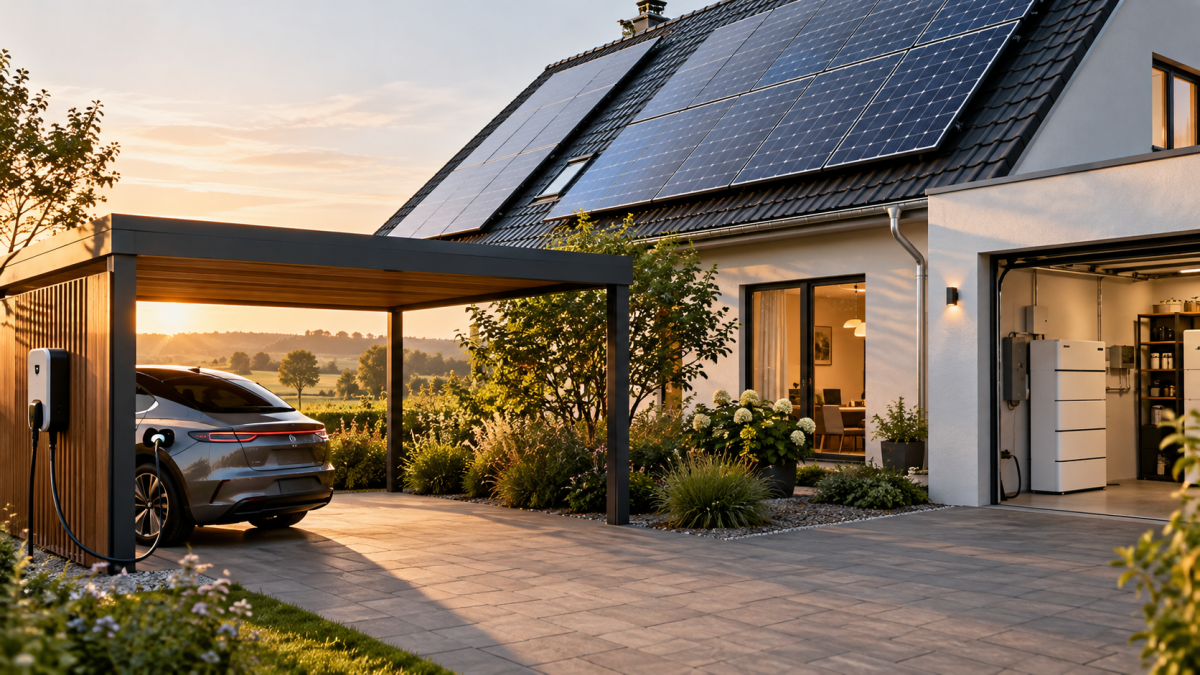
My house as a small power plant – with completely normal boundaries.
My solar system produces electricity – but when is it really cheap?
When it comes to solar power, I'm fascinated not only by the fact that electrical energy is generated on my own roof or balcony. It gets more interesting for me when asked what I do with it afterwards. A photovoltaic system can produce strong power at midday, while hardly any electricity is needed in the house right now. In the evening, however, the lighting, kitchen, and other devices run, even though the sun has long since called it quits. If you also own an electric car and a battery battery, you suddenly have several ways to distribute the energy. That sounds like a small power plant in your own household. Sometimes it feels more like a side job as an electricity supplier, but without the associated payroll.
Self-consumption is not the same as self-sufficiency
Basically, I have to distinguish between self-consumption and self-sufficiency. Self-consumption describes what proportion of the solar power generated is used directly or after intermediate storage. The degree of self-suffray, on the other hand, indicates how much of the total electricity demand is covered by the own system. These are two different indicators. A small system can consume almost all its electricity itself and still cover only a small part of the household's needs. A large system may produce significant surpluses, even though the household reaches a high degree of self-suffrage. Anyone looking at only a percentage can easily draw the wrong conclusions. In the end, the electricity bill is less interested in pretty diagrams than in the actual kilowatt-hours consumed.
A storage system shifts energy over time. It absorbs excess solar power during the day and releases it later. The Consumer Advice Center explains in a guide from July 2026 that this can increase the degree of self-sufficiency of a typical single-family home with a photovoltaic system from about 25 to 30 percent to up to 70 percent. This is a guideline, not a promise for every house. What matters are system performance, consumption profile, storage capacity, and season. Grid power often remains necessary, especially in winter. Anyone expecting to get all their household energy from a small storage unit in December is confusing a battery with a seasonal wonder box.
Memory losses and the correct order
I find storage losses particularly important. Electricity flowing into a battery does not fully come out again. Added to this are self-consumption of electronics, standby losses, and possible limitations to protect the cells. The consumer advice center cites 1,500 kilowatt-hours of stored energy annually as a typical example, of which about 1,200 kilowatt-hours are usable in the household. Around 300 kilowatt-hours are lost in this example calculation for losses and other effects. Therefore, it is not automatically economical to send every free kilowatt-hour through the storage first. If an electric car is connected during the day, direct charging with solar power can be cheaper, provided the technical system supports it and the required electricity is actually available.
Therefore, I would set priorities according to my own daily routine. If the car needs to be reliably ready at a certain charge level in the morning, supply security is more important than the last saved decimal place. If, on the other hand, it regularly stays at home at noon, a suitable control system can use surplus solar directly for charging. The home storage can then retain energy for the evening. Charging power, minimum vehicle charging power, technical switching options, and possibly phase switching play a role. Not every wallbox supports every function, and not every energy management system works seamlessly with all devices. On paper, this is often an intelligent overall system. In practice, it sometimes turns out that three manufacturers have promised a common language but speak different dialects.
With dynamic electricity tariffs, the bill becomes even more interesting. The market electricity price can fluctuate throughout the day, but the actual end customer price includes other components. Anyone who loads grid electricity into a storage system to use it later must therefore consider all supply costs, storage losses, and possible fees for fed-in solar power. A low market price alone does not prove an economic advantage. Even an oversized battery can become expensive if it is rarely used sensibly. For me, a sober calculation is more helpful than the promise of complete independence.
My conclusion: The technology should work, not me
The crucial question, therefore, is not how much technology I can install, but what tasks it can meaningfully fulfill. A well-coordinated system can reduce grid usage, use solar power more efficiently, and charge an electric car more cheaply. But it can also become unnecessarily complex and expensive if every new feature requires an additional controller, another app, and three hours of troubleshooting. I want my system to work while I take care of other things. Generating electricity myself feels good. Even better is if I don't have to hold a crisis meeting every evening with inverters, storage, and wallboxes.
You may also like

Made in China was cheap yesterday – today it will be inconvenient for Europe's car industry
China builds, Europe regulates – and in the end the customer pays I sometimes have the feeling that the European and Chinese car industries have been…
Read more →
How emission-free is my electric car really? A research.
The Hyundai Ioniq 5 is an all-electric crossover vehicle with a striking, futuristic design. Is my electric car really more environmentally friendly …
Read more →
Between punitive tariffs and seat heating subscription: Germany's e-car problem.
Why does China get cheap e-cars and we can't? I've been asking myself this for a long time. Why do Chinese manufacturers manage to bring electric car…
Read more →Want more between the blog posts? I share photos and short notes on Bluesky.
Comments
Write a comment