
Why is our electricity so expensive in Germany? Despite wind and sun?
Sun and wind don't send a bill – why is our electricity still so expensive?
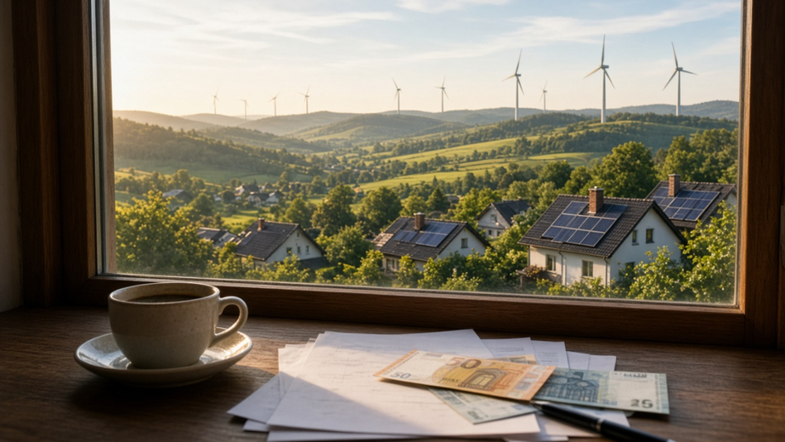
When I look around Germany, I see solar systems on more and more roofs. There are large solar parks in fields, and wind turbines are also being expanded. In the first half of 2026, around 58 percent of our electricity consumption already came from renewable energies. Actually, this should make electricity much cheaper. After all, sun and wind don't charge money, don't bill and don't threaten to raise prices.
Nevertheless, the price of electricity for private households remains high. At first, this seems to me as if something does not fit together in the energy transition. In fact, the explanation is somewhat more complicated. It is not so much because solar and wind power are particularly expensive. The problem is the entire system that has to be built, operated and paid for around this electricity.
The electricity itself is only part of my bill
When I pay my electricity bill, I don't just pay for the energy that comes out of my socket. There are several components in the final price. These include the purchase of electricity, the operation of the electricity grids, the electricity meter, the distribution of the provider, taxes, levies and levies.
So the actual electricity generation is only part of my bill. Even if the electricity costs almost nothing on the exchange for a few hours, the other costs remain. Unfortunately, my electricity meter doesn't say: "The sun is shining today, that's why there's the wash cycle on the house."
Since July 2022, the former EEG levy has no longer been paid directly via the electricity bill. However, this does not mean that the promotion of renewable energies has suddenly become free. These costs are now largely financed from the federal budget. They no longer appear as a separate item on my electricity bill, but they continue to be paid in the end – just in a different way.
Solar power is cheap, but not always available when I need it
A solar system produces a particularly large amount of electricity when the sun is shining at noon. However, the largest electricity consumption of many households occurs in the morning and evening. Then they cook, the washing machine runs, the TV is switched on and perhaps the electric car is charged.
It's a bit like the baker giving away his rolls mainly at noon, while I need them at seven in the morning. The offer is available, but unfortunately not always at the right time.
At night, solar systems do not provide any electricity at all. In winter, the days are short and the sun is lower. Wind turbines can also generate electricity at night and in winter, but only if there is enough wind. If it is dark and windless at the same time, experts speak of a dark doldrums. The name sounds like a bad mood, but it describes a real problem.
In such times, other power plants have to step in. These can be gas, coal, hydro or storage power plants. In addition, Germany can import electricity from abroad. These options must also be available if they are only needed temporarily. Their readiness alone costs money.
Why a gas-fired power plant can influence the price
To put it simply, a special principle applies to the electricity exchange: the power plants that can offer electricity at particularly low prices are used first. Solar and wind power are usually far ahead because they do not require any fuels.
If this electricity is not sufficient, more expensive power plants are gradually switched on. Often a gas-fired power plant is still needed in the end. The most expensive power plant needed to cover demand then often determines the exchange price for all power plants used.
This means that although a large part of the electricity was generated cheaply from wind and sun, an expensive gas-fired power plant can pull up the market price. This is about as if nine rolls were baked cheaply in the supermarket, but because the tenth roll was particularly expensive, the price for the whole order rises.
More renewable energies still help. The more often wind and solar plants cover the entire demand, the less often expensive gas or coal-fired power plants are needed. This reduces the average exchange price. However, this does not happen evenly at every time of day and year.
Why I don't notice low stock market prices right away
Electricity providers do not usually buy their energy spontaneously on the stock exchange every morning. They procure large parts months or even years in advance. In this way, they protect themselves and their customers from sharp price jumps.
There are two sides to this. If the stock market price suddenly rises, my tariff does not necessarily become more expensive immediately. If the price falls, however, my contract does not immediately become cheaper. Old and expensive purchase contracts continue to run for the time being.
In addition, each provider decides for itself how quickly it passes on lower purchase prices to its customers. Some providers react relatively quickly. Others discover price reductions about as quickly as a snail discovers the overtaking lane.
That's why it's worth checking your own tariff regularly. If you stay in the basic supply or in an old contract for years, you may pay significantly more than necessary. More solar and wind power can lower the market price. Whether the savings reach me, however, also depends on my provider and my contract.
The power grids cost a lot of money
Germany has to massively restructure its power grids. A large part of wind power is produced in the north. However, large industrial areas and consumption centers are also located in the south and west. The electricity must therefore be transported over long distances.
In addition, the local distribution grids must be expanded. In the past, electricity flowed mainly in one direction: from the large power plant via the grid to my house. Today, millions of solar systems also feed electricity into the grid. At the same time, heat pumps, wallboxes, battery storage systems and more and more electric cars are being added.
The old power grid was not built for these tasks. That's why new lines, transformers, substations, control systems and digital electricity meters are needed. This costs billions of euros. I pay part of it through grid fees.
For 2026, transmission grid fees have been significantly reduced through a government subsidy. For households, this should bring an average relief of about two cents per kilowatt hour, but regionally different. With an annual consumption of 3,500 kilowatt hours, two cents would be around 70 euros a year. That's nice, but not a reason to set up the fan heater in the garden for joy.
In addition, the costs do not disappear completely with a state subsidy. They are then partly paid for by taxpayers. This is a relief for my electricity bill, but it remains an expense for the state.
Sometimes we even have too much electricity
On sunny and windy days, more electricity can be produced at times than can be consumed or transported through the existing lines. Then the exchange prices can fall to zero or even below zero.
That sounds great at first. Nevertheless, as a normal customer, I usually don't get any money for it. If you have a classic tariff with a fixed price, you continue to pay your agreed amount per kilowatt hour.
It gets interesting with a dynamic electricity tariff. My energy price changes depending on the stock market situation. I can then use a washing machine, dishwasher, battery storage or electric car specifically at favourable hours. For this, I usually need an intelligent electricity meter and an accurate consumption meter.
However, dynamic tariffs can also swing in the other direction. If there is little electricity available and prices rise, consumption becomes expensive. If you can hardly shift your electricity consumption, you may be quieter with a fixed tariff. A dynamic tariff is not an ATM, but rather an electricity tariff with weather sensitivity.
Why electricity sometimes has to be curtailed
If a lot of wind power is generated in the north, but the lines to the south are at capacity, not all the electricity can be transported. In this case, wind turbines have to be partially turned down. At the same time, it may be necessary to start up a power plant at another location.
These interventions are called redispatch. They are important for keeping the power grid stable. However, they cause additional costs. In the end, cheap wind power may not be used, while expensive electricity has to be generated elsewhere.
That sounds crazy – and it is to a certain extent. But it shows why it is not enough to install more and more wind turbines and solar plants. Grid expansion, storage and intelligent control must grow at the same pace.
When will electricity finally become cheaper?
The honest answer is: No one can seriously name a fixed date. Anyone who claims that electricity is guaranteed to be cheap from a certain year onwards either has a very good crystal ball or wants to sell me something.
The first reliefs are already possible. The lower stock exchange prices, lower grid fees and competition between providers can lead to new contracts becoming cheaper. Therefore, a tariff comparison can make a difference today or at the next termination option.
I think a stronger and more permanent relief is more likely in the coming years. For this to happen, several things have to happen at the same time: even more renewable energies must be built, power grids completed, storage facilities expanded and flexible tariffs disseminated. In addition, there must be enough controllable power plants that can step in when there is no wind and darkness.
By 2030, the share of renewable energies in German electricity consumption is expected to rise to 80 percent. If grids, storage systems and digital control are expanded at the same time, cheap electricity hours could become much more frequent. People with electric cars, heat pumps or battery storage systems in particular could benefit from this because they can shift their consumption to these times.
I therefore expect a gradual development rather than a sudden drop in prices. By 2030, the pure costs of electricity generation could fall through the further expansion of wind and solar. Whether my final price will also fall significantly depends on grid fees, taxes, government decisions, gas prices and the behaviour of electricity suppliers.
It is even possible that electricity from the stock exchange will become cheaper, while grid costs will remain high or continue to rise. After all, the conversion will have to be paid for. Only when the most important lines and storage facilities have been built could these additional costs grow more slowly. A noticeable structural relief is therefore more likely to be expected towards the end of this decade and in the 2030s – but it is not guaranteed.
My conclusion
Solar and wind energy generally make electricity generation cheaper. So they are not useless just because my electricity bill is not immediately halved. Without them, Germany would be more dependent on coal, gas and their fluctuating world market prices.
The high price of electricity arises because I don't just pay for the electricity. I also pay for lines, reserve power plants, grid stability, taxes, levies, electricity meters and the complete restructuring of the energy system. In addition, cheap solar and wind power is not always available where it is needed.
More solar panels and wind turbines are therefore an important part of the solution, but not the whole solution. We also need more storage, faster power lines, smart meters and tariffs that actually make low exchange prices reach me.
The sun still doesn't send a bill. Unfortunately, the power grid, the state and my energy supplier are already doing it. Whether electricity will really become significantly cheaper in the coming years will therefore be decided not only on our roofs and wind turbines, but also in power plants, grids, storage facilities, authorities – and ultimately on my next electricity bill.
You may also like
Why repairs are often more expensive than new devices today
I grew up with a time when "broken" did not automatically mean: get rid of it. When the TV was no longer running, the first thing to do was to look a…
Read more →
Not all USB-C is the same – why the same cable can suddenly do completely different things
Actually, USB-C should make a lot of things easier. A plug for smartphone, tablet, laptop, headphones, power bank, monitor and now everything that ne…
Read more →
Between punitive tariffs and seat heating subscription: Germany's e-car problem.
Why does China get cheap e-cars and we can't? I've been asking myself this for a long time. Why do Chinese manufacturers manage to bring electric car…
Read more →Want more between the blog posts? I share photos and short notes on Bluesky.
Comments
Write a comment