
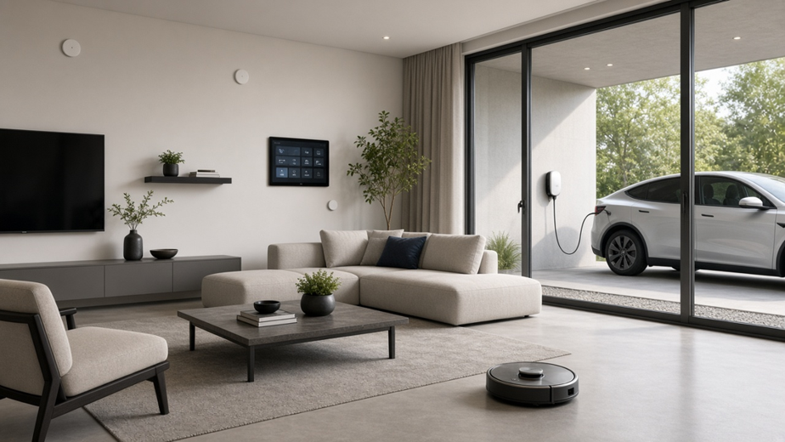
From device zoo to real smart home: what I expect from Matter.
Smart Home without Brand Marriage: Why Matter is Slowly Becoming Interesting for Me
When I look at how my smart home has developed over the years, I sometimes have to laugh a little myself. Actually, all the technology was supposed to make my life easier. Instead, at some point I realized that the lamp wants its own app, the camera too, of course, the roller shutter needs a different control panel and some sensor basically only wants to talk to exactly the gateway that I don't have, of course. Smart home sometimes means: I just want to turn on the lights – and first get training to become a network administrator. That's exactly why I find Matter increasingly interesting. The standard has existed for a few years, but now it's slowly becoming apparent what it could actually become. In the meantime, it's no longer just about lamps and sockets, but also about sensors, energy management, robot vacuum cleaners and, with newer Matter versions, other device categories such as cameras. For me, it's not so much the individual new gadget that is exciting. I'm more interested in the idea behind it: I want to be able to buy a device without entering into a marriage of several years with its manufacturer at the same time.
First of all, Matter is not a new wireless technology like Wi-Fi or Thread. It is a common standard that determines, among other things, how compatible smart home devices communicate with each other and what functions they offer compared to a smart home system. The connection can be made via Ethernet, WLAN or Thread, for example. Thread, on the other hand, is a low-power IP-based wireless network and is particularly suitable for sensors, switches and other devices that do not have to transmit huge amounts of data. I imagine Matter in simplified terms like a common language: Alexa, Google Home, Apple Home, Samsung SmartThings and the various device manufacturers have their own systems, but Matter creates a standardized level of communication. This does not mean that every device in every system suddenly has exactly the same functions. Manufacturers can continue to offer their own additional functions. However, basic collaboration should become much easier.
And that's exactly what I want from a smart home. When I buy a motion detector, I don't want to have to read a scientific paper about whether I need Bridge A, Hub B, or Gateway C. I want to mount the thing, connect it, and then specify that when motion is detected, turn on the lights. However, the technical hurdles haven't completely disappeared with Matter. The difference between a Matter controller and a Thread Border Router is particularly important. The Matter controller manages Matter devices within a smart home system. A Thread Border Router is also needed when devices use Matter over Thread because it connects the Thread network to the rest of the IP network.
I only realized the interesting thing about it when I took a closer look: At least for these two tasks, I don't need to buy an additional box from myself. My second-generation Echo Show 15 supports Matter and, according to Amazon, also has Thread border router functionality. So if I want to integrate a suitable Matter-over-Thread device into my Alexa system, the necessary infrastructure is basically already in place. I really like that, because in addition to routers, bridges and the control panels of my existing systems, I don't necessarily need a box whose power supply occupies the nearest socket. This is exactly where I see a big advantage of Matter in the long term: Ideally, I don't need more and more control panels, but existing devices can take on several tasks.
However, this does not mean that I can now dispose of my existing bridges and control panels. A good example is Philips Hue. My Hue devices continue to communicate with the Hue Bridge via Zigbee. However, the bridge can make compatible Hue devices available to other Matter systems via Matter. So I don't have to replace all the bulbs just because I want to use Matter. With other systems, it's a different story. Matter doesn't magically make older devices compatible. If an existing system needs its own control panel and doesn't offer a corresponding Matter connection, that control panel is still necessary. That's exactly why you should be a little careful with the nice advertising promise "everything works with everything" when it comes to Matter. We're not there yet.
Nevertheless, the standard is developing significantly. With Matter 1.5, which the Connectivity Standards Alliance released at the end of 2025, cameras, among other things, were included in the standard. It's not just about displaying a camera image somewhere. The specification takes into account functions such as live video and audio, two-way talk, motion events and, depending on the device, other camera functions. I find this particularly interesting because cameras have so far been among the smart home devices where you quickly end up in a manufacturer's ecosystem. The camera works great in the manufacturer's app and perhaps with certain other platforms – but as soon as I want to integrate it differently, the tinkering lesson begins. Matter at least creates a standardized basis here. However, this does not mean that every existing camera automatically becomes a Matter camera through a software update. What remains decisive is what the respective manufacturer actually supports for the specific model.
Personally, I find the topic of energy even more interesting. In recent versions, Matter has been expanded to include functions for energy management. This allows compatible devices to provide information on their energy consumption, for example, and the standard is increasingly creating the basis for a more intelligent interaction between energy generation, storage and consumption. This is exactly where smart homes are really starting to make sense for me. I don't necessarily need a lamp that can light up in 16 million colors on voice command. Nice, but at some point you get tired of turning your living room purple on command. I find the combination of photovoltaics, battery storage, electric car and intelligently controlled consumers much more interesting. If my solar system is producing a lot of electricity and energy is available, I want my house to be able to use such information sensibly in the long term. A flexible consumer could work, for example, if its own solar power is available or energy can be obtained particularly cheaply. For me, this is smart home with actual benefits and not just technology, because technology is possible.
That's why I like the idea of Matter that very different devices have a common technical basis. A soil moisture sensor is a good example of this. It doesn't have to look spectacular or talk to me. It simply measures whether the soil becomes dry. My smart home can derive a notification or an automatic irrigation system from this. There is no robot driving through the living room and greeting me by name in the morning. It simply prevents the basil from looking like an archaeological find after two weeks. That's enough for me. For me, that's a sensible automation: something happens in the background that actually relieves me of a small task.
Another point for me is local communication. I think a smart home doesn't have to make a phone call halfway through the Internet for every keystroke. If I press a switch and want to turn on a lamp in the same house, it seems reasonably logical to me that the information should not necessarily take a trip around the world through any data centers. Matter is based on IP communication and is basically designed for local communication between devices. However, this does not automatically mean that all functions of a manufacturer work without the cloud. Additional services, remote access, voice assistants or special manufacturer functions may still require Internet services. Here, too, the reality is a bit more complicated than the nice sentence "Matter works locally".
With my own smart home, I find it particularly interesting that I have different systems in use. This works in principle, but that's exactly where you realize at some point how absurd the classic smart home world is in some cases. Each system is intelligent in its own right. Some people just want to talk to each other about as much as two neighbors who have been at odds over a hedge for 14 years. Matter could tear down at least part of these walls. I don't expect that tomorrow all the devices in my house will suddenly become best friends. But if I don't have to think about whether I need another control panel for it in the future when I buy a sensor, switch or other device, a lot would already be gained.
Nevertheless, I remain cautious with new smart home devices. Not every device automatically becomes useful just because Matter, Thread or AI is written on the packaging. A networked toilet brush remains a networked toilet brush even with Matter. After all, the standard does not answer the question of what I should automate in the first place. Ideally, it should only simplify how my devices work with each other. For me, a smart home makes sense if I have to deal with it less after setup than before. Lights, shutters, energy consumption, security and certain routines can actually take work off my hands. If, on the other hand, I have to restart a gateway every other evening, update firmware and relearn some disappeared socket, I don't have a smart home, but have set up an unpaid part-time job.
That's why I don't see Matter as a spectacular new gadget. For me, it's more of an infrastructure in the background that could make my smart home more of an overall system in the long term. It's far from perfect. Manufacturers will continue to reserve additional functions for their own apps, not every existing device will support Matter afterwards and I'll probably continue to sit in front of some sensor from time to time in the future and wonder why this damn thing still worked yesterday. But I like the direction. I now have enough smart devices. Now it would be nice if they would finally talk to each other sensibly. And if at some point lamps, sockets, sensors, shutters, cameras, photovoltaics, battery storage and electric cars work together without me needing six apps, three bridges and a small nervous breakdown, then my home can actually call itself "smart" as far as I'm concerned.
Freric
Sources
Connectivity Standards Alliance – Matter: official information on the standard and how it works
Connectivity Standards Alliance – Matter 1.5: Enhancements for cameras and energy management, among other things
Amazon Developer – Matter support and Thread Border Router on compatible Echo devices
Philips Hue – Matter support via the Hue Bridge
Thread Group – technical basics and functionality of Thread
You may also like

Artificial Intelligence for Ordinary People – No Computer Science Degree at All
My second brain doesn't finish work – but sometimes I have no idea Artificial intelligence is now everywhere. My smartphone has AI, my computer has A…
Read more →
I like technology – but my toaster really doesn't need a subscription.
I really have enough technology around me now to be able to say that I'm no longer automatically impressed with many things just because it says "sma…
Read more →
When the fridge is smarter than its owner: Does AI really have to be in everything?
Artificial intelligence is everywhere by now. In the smartphone, the television, the car, in photo apps, search engines, office programs, washing mac…
Read more →Want more between the blog posts? I share photos and short notes on Bluesky.
Comments
Write a comment