
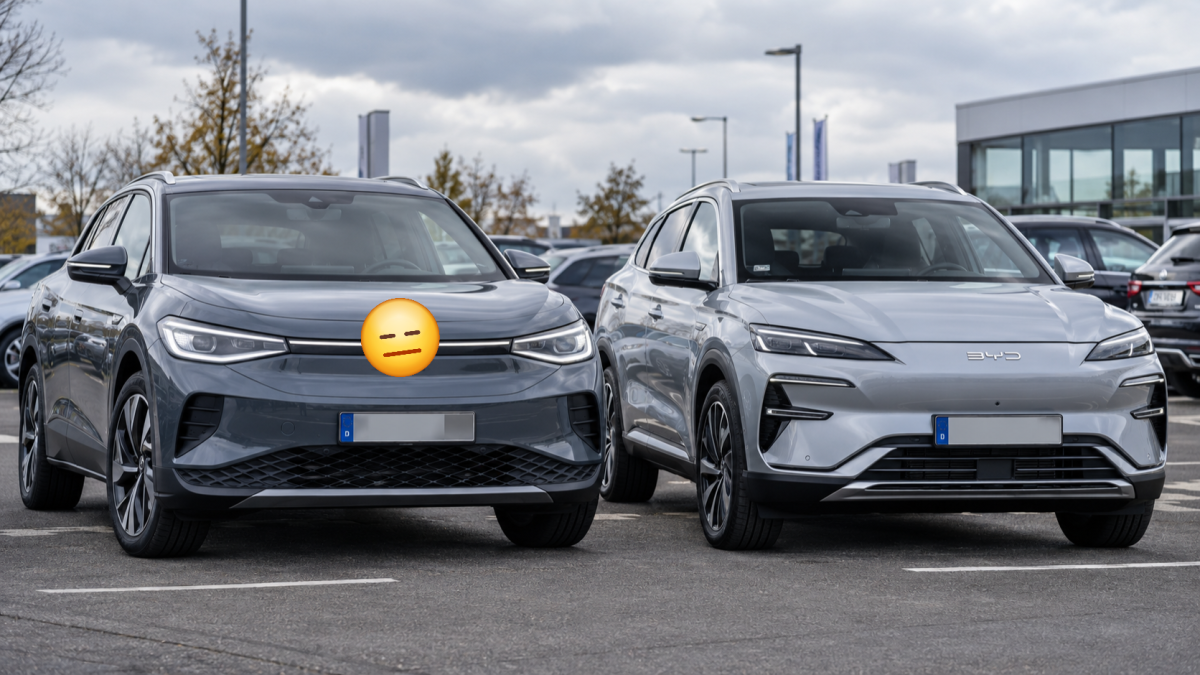
VW is recalling thousands of cars again – and I'm thinking about China.
German engineering – and yet another recall at Volkswagen
It wasn't that long ago that I dealt with the question in a blog post about why I might prefer a Chinese manufacturer for my next car purchase. Among other things, it was about prices, equipment, and technical developments. One topic now deserves its own contribution: the much-invoked German quality.
The current recall
On October 20, 2026, Tagesschau reported that Volkswagen has to recall nearly 72,700 electric cars worldwide due to faulty battery cells. Around 10,000 vehicles are affected in Germany alone. This includes models such as the ID.3, ID.4, ID.7, ID. Buzz, and the Cupra Born. According to Volkswagen, internal quality inspections have shown that certain high-voltage battery cells do not meet the requirements. The company cites production defects among suppliers as the cause. In the worst case, the batteries can overheat and cause a fire. Until the inspection, affected vehicles are therefore only to be charged up to a maximum of 80 percent. Where technically possible, this limit is even activated automatically. According to the Federal Motor Transport Authority, no personal injury or property damage was initially known.
Not the first recall this year
One could say that mistakes happen, and a recall ultimately shows that a manufacturer is fulfilling its responsibility. That is fundamentally correct. However, this explanation takes on a strange undertone when you look at what happened at Volkswagen alone this year. Already in March 2026, Volkswagen and Cupra had to recall more than 90,000 electric cars worldwide due to battery problems. At the end of September, around five million vehicles were recalled due to a corrosion-prone screw on the steering. And now, just a few weeks later, almost 72,700 electric cars are once again at the center of a safety-relevant recall.
Of course, you have to interpret these numbers correctly. Not every recalled vehicle actually has a defect, and without the respective production volumes, recall numbers from different manufacturers can only be compared to a limited extent. Still, we're not talking about a squeaky door handle or a radio that occasionally forgets its favorite station. It's about batteries that could ignite in extreme cases, and about a component that can impair the steering system's function. For me, the fun ends with such components.
What remains of the reputation of German engineering
I belong to a generation for which German cars had a special reputation for a long time. Mercedes stood for solid craftsmanship, BMW for mature technology, and Volkswagen for reliable vehicles. German engineering was not just an advertising promise, but for many people, it was actually a buying argument. Those who bought a German car often paid a bit more, but in return felt they were getting a particularly well-thought-out and durable product. By now, however, I wonder how much of this promise of quality remains.
Of course, I don't expect modern cars to be completely flawless. They have become far too complex technically. But this complexity should not be a free pass for experienced manufacturers. Anyone who advertises with decades of engineering experience and demands correspondingly high prices must also be measured against this standard.
Only 80 percent load now – the customer bears the consequences
What I find particularly annoying is the instruction to charge affected electric cars to only up to 80 percent for now. Of course, this is understandable as a safety measure. But from the customer's perspective, it initially means that a costly vehicle can no longer be used without restrictions. For example, someone who chose a certain model based on the stated range may now have to plan additional charging stops. Especially in winter, when the range is already shorter, this is anything but pleasant. The cause may lie with the supplier; the inconvenience is initially with the customer. And from my point of view, the responsible party remains with the manufacturer from whom I bought the vehicle.
Are Chinese cars better?
Are Chinese cars better because of that? That cannot be inferred from that. Chinese manufacturers also have quality problems, software errors, and recalls. Moreover, they still have to prove their long-term quality, spare parts supply, and workshop networks in some cases. But that is exactly what matters to me: Why should I give a German manufacturer an advance of trust solely because of its origin? Why should I pay more for a comparable vehicle if I cannot clearly recognize the claimed quality advantage?
Globalization has long since ensured that the origin of a vehicle is less obvious than the brand logo suggests. Electronics, battery cells, and numerous other components come from international supply chains. Therefore, the decisive factor should be how reliably the finished product works and how the manufacturer handles problems. Whether its headquarters is in Wolfsburg, Munich, or Shenzhen plays a minor role for me.
My conclusion: Quality has no nationality
By the way, I do not criticize Volkswagen for recalling faulty vehicles. The opposite would be much worse. A recall shows that a recognized problem is being addressed. However, it does not change the fact that something went wrong in development, production, or quality assurance beforehand. If several safety-relevant recalls accumulate within a few months, one can certainly ask whether the traditional quality standard still corresponds to reality.
I have nothing against German cars. On the contrary. I would welcome it if the German automotive industry continues to be technically leading, economically successful, and produces high-quality vehicles in the future. After all, many jobs in Germany depend directly or indirectly on this industry. But this does not oblige me to fundamentally prefer a German manufacturer when buying a car. If I spend several tens of thousands of euros, I want to get a fair return: good equipment, reliable technology, transparent prices, and a manufacturer who stands by their product even after purchase.
The current recalls do not prove that Chinese vehicles are fundamentally better. However, they provide another reason to critically question the alleged quality lead of German manufacturers. Perhaps we should finally let go of the idea that quality has a nationality.
German engineering can be a good argument. It is not a free pass for higher prices.
And if in the end a Chinese vehicle convinces me more than a German one, then I won't have to justify myself for it. After all, I'm buying a car and not a national loyalty declaration.
---
Sources (as of October 21, 2026)
- "Tagesschau – VW recalls more than 70,000 electric cars worldwide" (https://www.tagesschau.de/wirtschaft/unternehmen/vw-e-autos-rueckruf-100.html)
The recall numbers mentioned refer to individual actions. Vehicles may be affected by more than one measure.
You may also like

Made in China was cheap yesterday – today it will be inconvenient for Europe's car industry
China builds, Europe regulates – and in the end the customer pays I sometimes have the feeling that the European and Chinese car industries have been…
Read more →
Between punitive tariffs and seat heating subscription: Germany's e-car problem.
Why does China get cheap e-cars and we can't? I've been asking myself this for a long time. Why do Chinese manufacturers manage to bring electric car…
Read more →Bought is bought? Not if the manufacturer still wants to make a profit.
Purchased, paid, and yet not my property? Welcome to digital serfdom I love technology. That probably isn't much of a secret anymore. When a new devi…
Read more →Want more between the blog posts? I share photos and short notes on Bluesky.
Comments
Write a comment