
When the fridge is smarter than its owner: Does AI really have to be in everything?
Artificial intelligence is everywhere by now. In the smartphone, the television, the car, in photo apps, search engines, office programs, washing machines, refrigerators, and it probably won't be long before my toaster analyses my mood in the morning and informs me that two slices of wholemeal bread would be the more sensible choice given my past life choices. That sounds exaggerated, but that is exactly how this development sometimes feels. Barely any manufacturer seems able to bring a product to market anymore without sticking "AI", "Smart AI", "AI powered" or "AI optimized" somewhere on it. In the past, much of this was simply called automatic. Today, it apparently needs an English name, a little asterisk behind the product designation and ideally a promotional video in which someone stands in awe in front of a refrigerator because it has recognised that the milk is almost gone.
Fundamentally, I have nothing against artificial intelligence at all. Quite the contrary. I use it myself and find many applications exceptionally useful. When an AI evaluates large amounts of data, summarises texts, improves translations, sorts images, finds errors or explains complicated information in an understandable way, then that is precisely the kind of technology I want to have. It takes away work, saves time and can make things possible that were previously more cumbersome or not possible at all.
And just so the impression doesn't arise that someone is writing here who would rather live with a rotary dial telephone and a cathode-ray tube television: I myself have a smart television, a pretty good smartphone, a tablet, a PC and a laptop. I use modern technology daily and quite gladly. So I am certainly no opponent of the future. I have nothing against devices becoming more intelligent. I only have something against being sold something as intelligent that, upon closer inspection, mainly consists of a new sticker and a marketing department with too much coffee.
That is precisely where an increasingly big problem lies for me. Many products are advertised with AI today, even though behind the function either automatic systems known for years are at work or the alleged intelligence brings hardly any real added value in everyday life. A simple image recognition suddenly becomes "AI Vision", an automatic brightness adjustment becomes "AI Display Intelligence" and a washing machine that recognises how much laundry is in the drum almost becomes a digital marvel. Technically, modern software may well be working in the background, but that by no means justifies every advertising message. Not everything that says AI on it actually contains something worthy of the name. Sometimes it is simply a deceptive package.
So the problem does not begin with the AI itself. The problem begins where it turns from a tool into a marketing sticker and every manufacturer suddenly acts as if even the most banal device urgently needs to learn to think. Sometimes I have the impression that development departments no longer ask: "What problem can we solve for the customer?", but rather: "Where can we squeeze in some AI function so that the product looks five years more modern on the packaging?" And then functions are created that sound technically impressive, but in everyday life are roughly as necessary as a voice assistant in an egg boiler.
Of course, my smartphone can now recognise faces, remove objects from images, artificially brighten night shots and turn an average sunset into a photo where even nature might think it might have done a somewhat sloppy job back then. That is certainly practical. But do I additionally need an AI that explains to me which notification is supposedly important for me? If my wife writes that I should bring milk, that is important. If some app tells me that I can "discover new offers now", then I frankly don't care whether a neural network thought about that beforehand.
You can see this AI madness particularly nicely with household appliances. Washing machines recognise fabric types, load capacities, degrees of soiling and soon presumably how optimistic I was in the morning when I put on a white T-shirt. My expectation of a washing machine is, however, astonishingly conservative. I want to put dirty laundry in and take clean laundry back out again. If it doesn't flood the apartment in the process, I would already be highly satisfied. I don't need an emotional relationship with it. It doesn't need to get to know me either. It doesn't need to report in the morning that it has detected increased sock activity based on my last twelve wash cycles. It should wash. Finished. That would already be intelligent technology for me.
With the refrigerator it gets even more absurd. It now recognises food, can keep shopping lists and sometimes even suggest recipes. Technically speaking, that is interesting. Practically, I imagine at some point the message: "In the refrigerator are three slices of cheese, two yoghurts, half a cucumber and no sensible basis for dinner." Thank you, refrigerator. That is precisely the form of humiliation I was waiting for. Perhaps it will report to me afterwards that I have opened the door for the fourth time after 22 o'clock this week and recommend nutritional counselling to me. At the latest at this point, I would like my grandparents' old refrigerator back. It couldn't do anything except cool, but for that it also wasn't offended if you ignored it.
Televisions are also small computer centres by now. I have a smart television myself and know how practical such devices can be. Open streaming services directly, use apps, search content, mirror the smartphone – all good. But the same applies here: A sensible digital function is by no means an artificial intelligence. Today, even the automatic adjustment of picture and sound is gladly sold as if the television had just independently studied physics. Yet it often only does something that good devices have been handling for years. The label has changed, the function not necessarily.
In the past, you turned on a television and then there was a picture. Today, you first set up an account, connect the device to Wi-Fi, accept privacy policies, install an update, log into three streaming services and are subsequently asked whether you want to activate personalised recommendations. If you say no, the device feels like it asks twice more whether you are really sure. At some point you sit on the sofa, have made settings for 20 minutes and no longer know which film you actually wanted to see. Technical progress then means above all that the device knows exactly what I probably want to see, while I myself have long since lost the desire.
Technology is of course also useful in the car as long as it genuinely helps. An emergency brake assist can save lives. A blind spot monitor can prevent accidents. A good lane keeping assist can provide sensible support. Those are clear advantages. But at the same time, more and more simple functions are disappearing into touchscreens and submenus. In the past, there was a button for the seat heating. You pressed it and your bottom got warm. That was an almost ingenious operating concept. Today, you partly have to tap on a display first, open a menu, select the climate control and hope that the software doesn't just decide to install an update right then. When the seat is finally warm, in the worst case you have already reached your destination and can get out again.
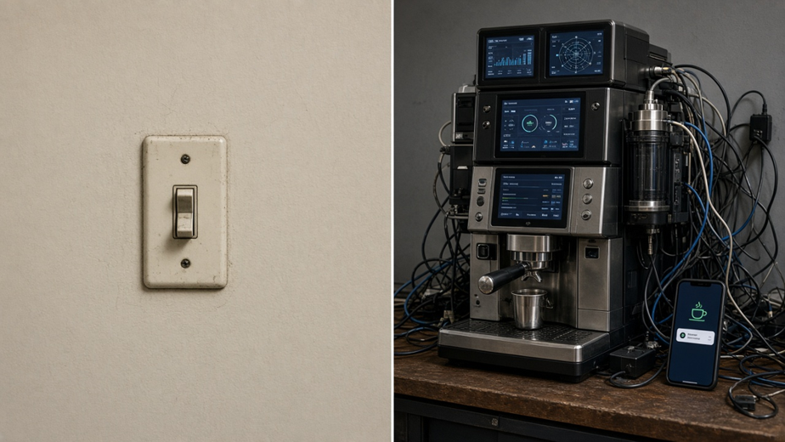
You have to realise just how ingenious a normal button actually was. It needed no user account, no Wi-Fi, no cloud, no privacy policies and no software update. It even functioned when the manufacturer had gone bankrupt in the meantime. You pressed it and something happened. Today, such a button almost looks like a historical technology from a time when products still had the outrageous habit of simply functioning.
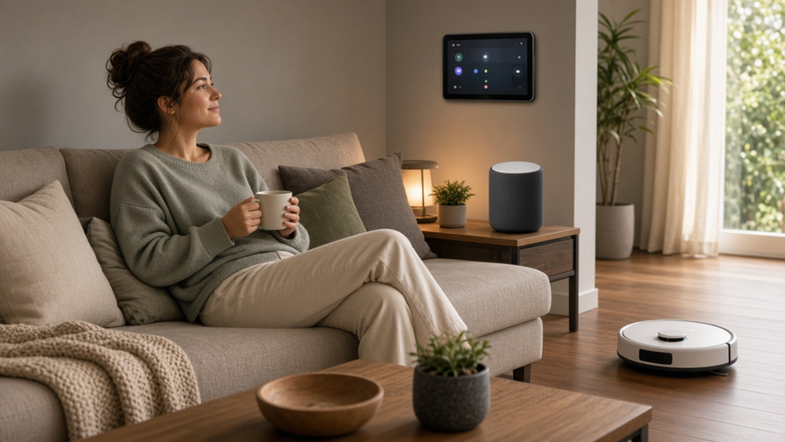
The actual problem for me is therefore not artificial intelligence, but the compulsion to turn every object into a digital ecosystem. One device is apparently no longer enough. It needs an app, an account, a cloud, a newsletter, a privacy agreement and ideally a subscription on top. At some point you no longer buy a vacuum cleaner, but rather enter into a long-term business relationship with a floor cleaning provider. The vacuum cleaner maps the apartment, recognises furniture, plans routes and sends data to some cloud. In the end, some server somewhere in the world probably knows better than I do where my sofa is. In the past, only the person who stubbed their little toe on it at night knew that.
This brings us to the more unpleasant part of this brave new world: the data. Because an AI that is supposed to truly support me personally has to know me. And the better it is supposed to know me, the more it has to know about me. What do I watch? What do I buy? Where do I drive? When am I at home? When do I sleep? What photos do I take? What music do I listen to? What products do I order? How often do I open the refrigerator at night? Each individual piece of information may seem harmless on its own. Taken together, however, they result in a pretty precise picture of a human being. And precisely here, convenience turns into surveillance with a friendly user interface at some point.
Of course, many things can be switched off. At least theoretically. Practically, the corresponding switches like to hide under privacy, advanced settings, further options, personalised services and "learn more". After 15 minutes you no longer know what you originally wanted to deactivate, but have accidentally activated three new functions instead and confirmed somewhere that your own data may be used to "improve the user experience". That always sounds so friendly. Nobody writes: "We want to know as much as possible about you so that we can make money with it." No, it is of course only about my user experience. How caring.
Marketing additionally pushes the whole thing to the point of being ridiculous. Today, it apparently no longer suffices if a device is simply good. It has to have AI Vision, AI Assistant, AI Smart, AI Engine or AI something. The term is used so inflationarily by now that it says almost nothing anymore. If a television automatically adjusts the brightness, that used to be a sensor. Today it is artificial intelligence. If a washing machine recognises the load, that used to be automatic load adjustment. Today it is AI Laundry Intelligence. The technical process does not even have to be fundamentally new. What matters above all is that the designation sounds like Silicon Valley and offers enough space for a logo on the packaging.
And precisely for this reason, AI is becoming a deceptive package more and more frequently in my opinion. The term has such advertising value that manufacturers want to cram it in everywhere possible. That is understandable, but not very helpful for customers. Because in the end, real artificial intelligence is lumped together with ordinary automation, statistical procedures and sometimes simple rules. To the buyer, everything sounds like high tech, even though the actual function is sometimes astonishingly limited.
The whole thing would only be amusing if it didn't give rise to another problem: products are becoming more complex and thus often more prone to errors. A simple device can usually only break in a few ways. An intelligent device can additionally get problems with software, servers, accounts, apps, Wi-Fi, cloud services and updates. Then the refrigerator might still function flawlessly technically, but the app claims it is offline. Or the vacuum cleaner no longer runs because it can no longer log in after an update. Or the television suddenly forgets a setting because some software was changed. These are problems one didn't have in the past because the device simply wasn't intelligent enough to invent new errors.
It gets particularly absurd when devices lose functions at some point because a manufacturer discontinues a service. Then you do own the hardware, but a part of it becomes useless because a server was switched off somewhere. That is probably the modern form of progress: The device still functions, but someone else has decided that it should no longer do so.
Precisely for this reason, I do not wish for less technology. I wish for better technology. I want artificial intelligence where it genuinely achieves something. It may analyse medical images, improve traffic flows, evaluate data, create translations, support people in their work or take annoying routine tasks off my hands. Very gladly. But my light switch does not need to learn when I normally go into the living room. My refrigerator does not need to evaluate my eating habits. My washing machine does not need a personality profile of me and my television does not need to try to become my best friend.
So I am most certainly not an opponent of progress. I use enough modern technology myself to know how pleasant it can be. I just don't want to automatically find every new function great just because AI is written somewhere on it. A good smartphone remains a good smartphone, even without 25 AI stickers. A good television above all has to deliver a good picture. A good computer should be fast and reliable. And a sensible AI function is in the end not recognised by how often the term "AI" stands on the packaging, but by whether it actually brings you something in everyday life.
Above all, manufacturers should finally understand again that simplicity can also be progress. A product that functions reliably, is easy to operate and lasts for 10 years is considerably more intelligent to me than a device with 25 AI functions, of which 20 nobody uses and 5 no longer work after the next update.
By the way, if one day my refrigerator, my washing machine and my television start exchanging data and together come to the conclusion that I don't have my life under control, I will react in a thoroughly old-fashioned way. I will pull the plug.
Astonishingly, that still works.
At least as long as the plug doesn't need a user account at some point too.
Freric
You may also like
I like technology – but my toaster really doesn't need a subscription.
I really have enough technology around me now to be able to say that I'm no longer automatically impressed with many things just because it says "sma…
Read more →
Artificial Intelligence for Ordinary People – No Computer Science Degree at All
My second brain doesn't finish work – but sometimes I have no idea Artificial intelligence is now everywhere. My smartphone has AI, my computer has A…
Read more →Bought is bought? Not if the manufacturer still wants to make a profit.
Purchased, paid, and yet not my property? Welcome to digital serfdom I love technology. That probably isn't much of a secret anymore. When a new devi…
Read more →Want more between the blog posts? I share photos and short notes on Bluesky.
Comments
Write a comment