
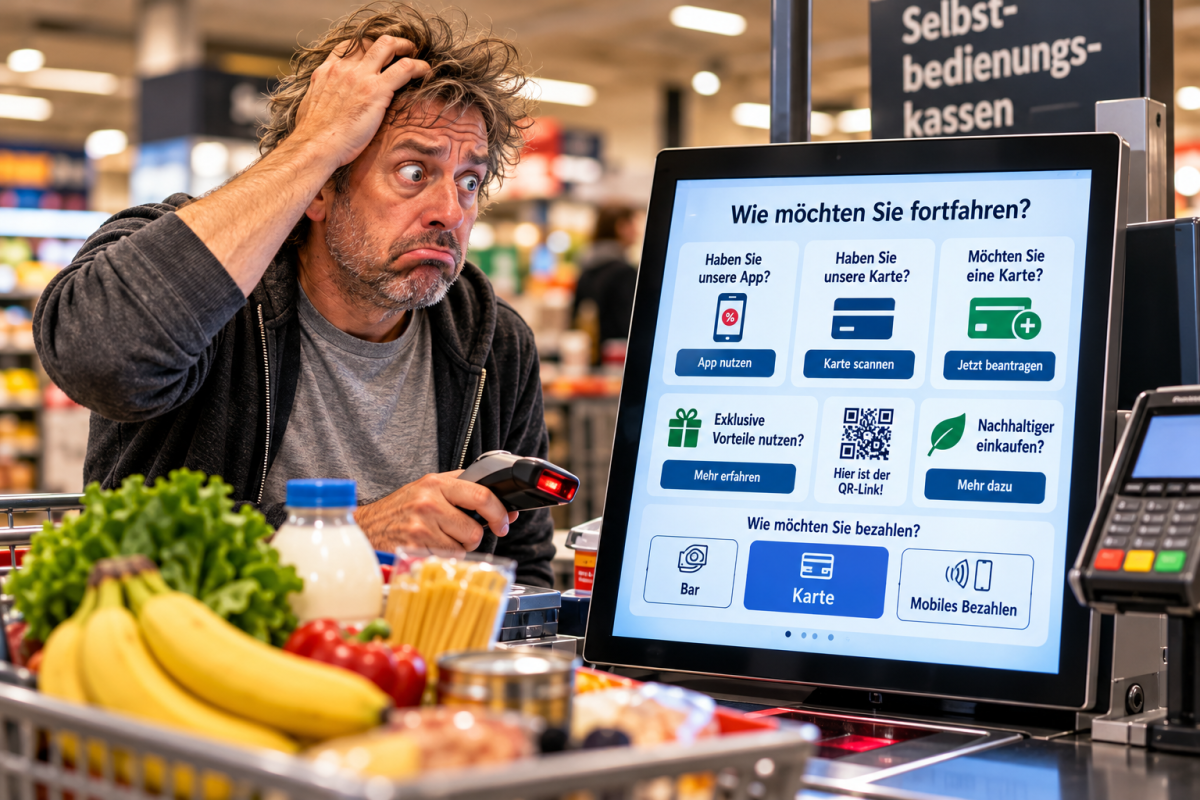
Do your own thing! Welcome to the supermarket of the future!
Self-service checkouts: Do your own thing – and pay the full price!
There are developments where I wonder whether we are actually making progress or if we are simply being taught more and more skillfully to take over other people's work. Self-service checkouts clearly belong in this category for me. The motto apparently is: "Do your own crap!" And as quickly as possible, as error-free as possible, and under video surveillance, if the market uses one. After all, the supermarket wants to ensure that its newly hired, unpaid assistants work properly. I now regularly work as a cashier. However, I have not yet received an employment contract. It is probably somewhere between special offers and the empty goods vending machine.
Three approvals for one purchase
Recently, I only wanted to buy a few things. There were some customers at the regular checkout, and the self-service checkouts were available next to them. So I chose the modern version. I took my items, looked for the barcodes, and started working. At first, everything went perfectly. I was quick, focused, and almost congratulated myself on being named employee of the month. But then the checkout decided that she didn't like something. Of course, she didn't tell me exactly what. Instead, the request appeared to wait for an employee. A cashier came, entered a number, and disappeared again. I kept going. Two items later, it was over again. Again the cashier, again the number, again the approval. The third time, I seriously considered whether to apologize to her or just hand over my shopping cart to her. I slowly felt like the cash register and I were in a relationship crisis. She didn't want to tell me what was bothering her, and I didn't know what else to do right.
Of course, the cashier couldn't help it. She was busy anyway and now had to pay for my technical incompetence, even though I was just trying to do her job. An absurd system: I take over the cashing, the technology prevents it, and in the end, the cashier has to come anyway. A real win-win situation. I just haven't figured out who will win yet.
The interrogation on screen
And anyone who thinks scanning is done apparently hasn't visited a modern self-service checkout for a long time. Because now the real interrogation begins. "Do you have our app?" No. "Do you have our loyalty card?" Not either. "Would you like a loyalty card?" No, thanks. "Then maybe our app?" Still not. "Here you can scan the QR code!" I just want to pay. "Are you sure you want to give up our exclusive benefits?" Yes. Even extremely secure. "With our app, you could save on your next purchase!" Wonderful. However, I could also save time on my current shopping if this screen finally let me pay for it.
Sometimes I feel like the checkout takes my rejection personally. They can't believe that someone enters a supermarket without wanting to build a lasting digital relationship with them afterward. I don't need an app for every pack of noodles and no push notification when yogurt is on offer somewhere. If every store, every gas station, and bakery gets its own app, I will eventually need a second phone. The first will then be solely responsible for reminding me to take the second one with me.
Paying as a practical exam
After the fifth attempt to get excited about some bonus program, I'm finally allowed to pay. At least almost. "How would you like to pay?" With money, would be my spontaneous answer. "Cash or with card?" With card. "Please pay attention to the instructions on the screen." Of course. I have nothing else planned. "Please hold your card to the terminal." I hold it out. Nothing happens. "Please wait." I wait. "Please hold the card again." I obey. By now, I'm no longer sure whether I'm shopping or taking a practical test for premium payments.
With cash, it can get even more entertaining. I slide a banknote into the machine. He pulls it in a bit, thinks for a moment, and spits it out again. I turn the bill over, smooth it carefully, and try again. Nothing. Maybe my money has the wrong hairstyle. Finally, I find out that accepting cash isn't working right now. So it's a card after all. The machine probably thinks: If you'd listened to me right away, we'd both be done long ago.
In the past, the cashier might have asked, "Are you collecting points?" I said no, she said, "All right," and the matter was settled. Today, it can become a multi-stage digital persuasion process. All that's left is the question of whether I am truly happy with my decision and want to participate in a customer satisfaction survey before paying.
Better an annoyed cashier than a motivated screen
While I wait for the screen to finally let me go, I think of the good old checkout with the conveyor belt. You put your goods on it, a person scans them, you pay, and leave. Sometimes there's a kind word, a brief conversation, or a smile. Maybe you've even known the cashier for a while. And yes, sometimes there's someone sitting there who's stressed and whose facial expression says something like, "If someone asks if the cucumbers are on sale, I'll cancel." That's part of life too. Sometimes I prefer an annoyed cashier over a highly motivated screen. Not every contact has to be profound. But a "Good day" or a short joke are actually more pleasant than an error message.
The customer as an unpaid employee
The principle is by no means new. IKEA showed some time ago how to motivate customers to participate. First, you gather your furniture in the warehouse yourself, carry the packages onto the cart, drive them to the checkout, and scan them. Then you transport everything home and assemble it. For a single cabinet, you worked as a warehouse worker, cashier, freight forwarder, and furniture assembler. At the self-service checkouts, for example, there are four checkouts and one employee who checks whether everything is properly scanned and paid for. Four customers work, one employee supervises everything. If you phrase it skillfully, it sounds like a modern management concept.
The employee is not to be envied. She has to manage several cash registers simultaneously, solve technical problems, issue age ratings, and make sure no one misses anything. Presumably, after work, she has more steps on her fitness bracelet than a half marathon runner. At the same time, I am promoted as a customer to cashier but am not allowed to collect unsupervised. So I am both an employee and a potential suspect. That's how I imagine a particularly trusting working atmosphere.
Self-service checkouts are no longer uncommon. According to the EHI Retail Institute, they were already available in more than 10,000 stores in Germany by 2025. Their number is growing significantly. At this pace, the classic checkout belt will eventually be in the museum, right next to the phone booth. Children will stand in front of it and ask: "Dad, what is that?" And I will answer: "That was a time when customers were simply allowed to shop." Also read: Save the city center or save money? The difficult balancing act when shopping
Good reasons, but for whom?
Of course, there are understandable reasons for this development. Retailers are struggling with staff shortages and rising costs. Self-service checkouts can shorten waiting times and relieve employees. If they work, they are quite practical, especially for a few items. But as a customer, I can ask what I gain if I do the work myself and still pay the same price. There isn't even an employee discount. I would be satisfied with little: two percent discount or a certificate saying "Scanned twelve items today and only needed help three times."
It also becomes clear with cash that modern technology does not automatically mean more freedom of choice. Many self-service checkouts accept only cards, although many people still like to pay in cash. The development is no longer limited to retail. We book trips ourselves, check in at the airport ourselves, manage contracts via apps, and discuss problems with chatbots. Much of this is practical; some especially saves companies work. Digitalization should make everyday life easier and not just shift tasks onto customers.
My conclusion: Freedom of choice instead of coercion
Therefore, I neither want to abolish self-service checkouts nor declare the classic checkout a sacred cultural asset. Those who want to cash themselves should gladly do so. Those who prefer to put their purchases on a conveyor belt and be served by a person should also have this option. For me, progress means creating additional opportunities instead of gradually abolishing personal service.
After my third technical incident, I seriously considered whether I would go back to the good old assembly line for my next purchase. As long as it still exists. Maybe I'll have to wait a bit longer there. For that, I might get a kind word, a smile, or at least a cashier who tells me directly if something isn't working.
And if the traditional cash register really does disappear one day, I would at least like an employment contract, paid vacation, Christmas bonus, and a works council for self-collecting customers.
The first agenda item is already set: After three necessary employee releases, the customer must be released from work for the rest of their purchases. With full pay, of course.
And at the exit, I'd like someone to kindly wish me a nice day.
I would even pay for that myself again.
Freric
---
Sources and further information
- "EHI Retail Institute – Every 18th cash register is a self-service cash register, November 5, 2025" (https://www.ehi.org/presse/jede-18-kasse-ist-sb-kasse/)
- "EHI Self-Checkout Initiative – Market Survey 2025" (https://www.self-checkout-initiative.de/markterhebung-2025/)
- "Deutsche Bundesbank – Payment Behavior in Germany 2025, published on June 17, 2026" (https://www.bundesbank.de/de/presse/pressemitteilungen/zahlungsverhalten-in-deutschland-2025-964736)
- "Consumer Advice Center Hamburg – What is allowed in the supermarket and what is not?" (https://www.vzhh.de/themen/lebensmittel-ernaehrung/einkaufsfalle-supermarkt/was-ist-im-supermarkt-erlaubt-was-nicht)
You may also like

Not all USB-C is the same – why the same cable can suddenly do completely different things
Actually, USB-C should make a lot of things easier. A plug for smartphone, tablet, laptop, headphones, power bank, monitor and now everything that ne…
Read more →
My smartwatch knows when I'm asleep – but why does Google need to know that?
I find smartwatches extremely practical. These small devices no longer just show me the time, but count my steps, measure my pulse, monitor my sleep,…
Read more →
Artificial Intelligence for Ordinary People – No Computer Science Degree at All
My second brain doesn't finish work – but sometimes I have no idea Artificial intelligence is now everywhere. My smartphone has AI, my computer has A…
Read more →Want more between the blog posts? I share photos and short notes on Bluesky.
Comments
Write a comment