
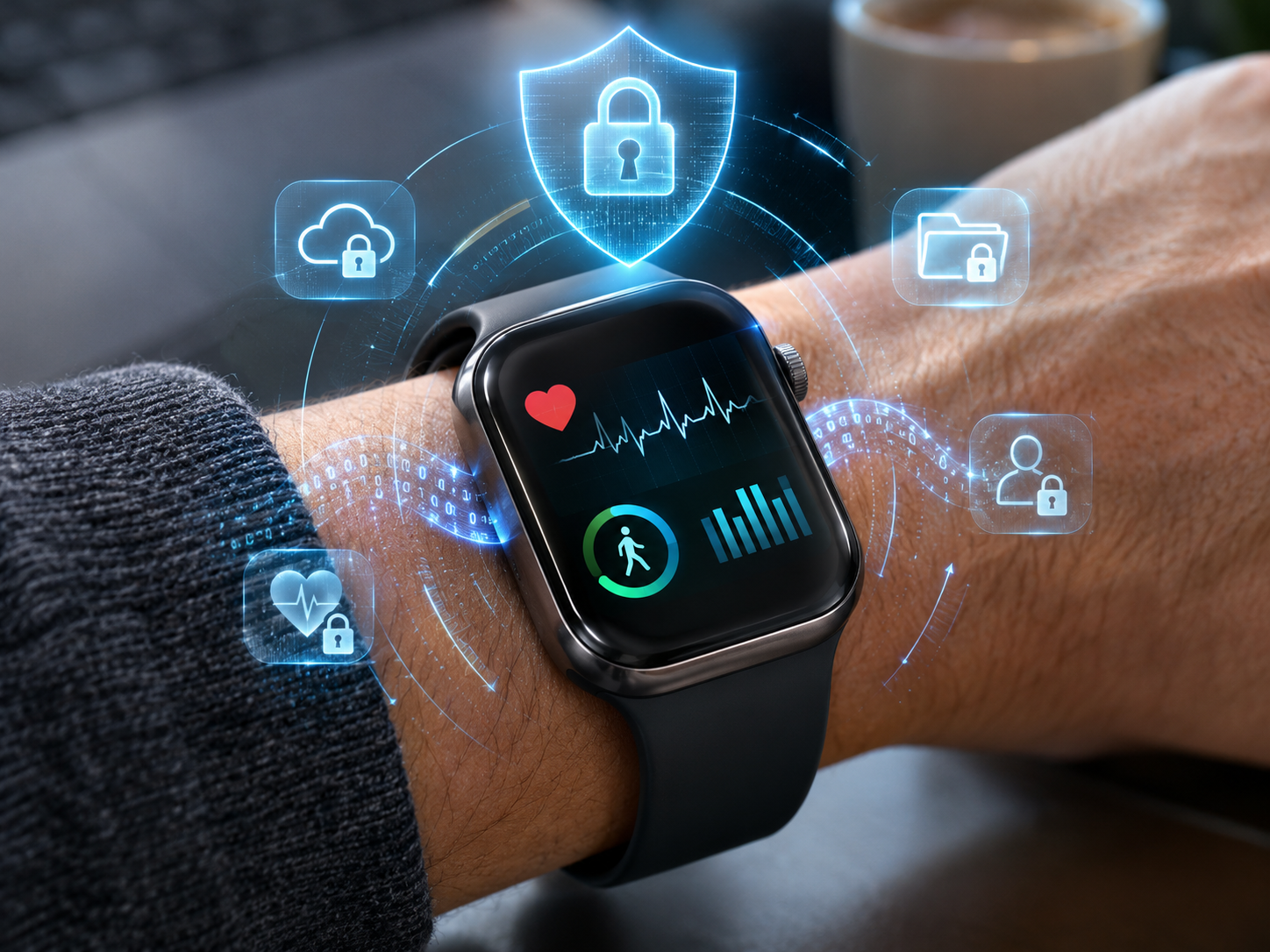
My smartwatch knows when I'm asleep – but why does Google need to know that?
I find smartwatches extremely practical. These small devices no longer just show me the time, but count my steps, measure my pulse, monitor my sleep, and can then explain to me how healthy or unhealthy I supposedly live. Sometimes my watch apparently knows better than I do in the morning whether I am well rested. At least it claims so with a confidence that I find utterly enviable after a bad night. But with all these technical possibilities, a completely different question occupies me: Why do Google, Samsung, and other companies actually need to know so much about me? What does a billionaire corporation care about when I go to bed, how often I wake up at night, or whether my pulse rises in the afternoon? And above all: What do these companies do with the information they collect about me?
Let's take something completely harmless. My smartwatch records that I walked 6,000 steps yesterday. This single number is pretty uninteresting. But if my steps are recorded every day, a picture of my habits emerges over weeks and months. When do I move especially much? On which days am I less active? When does my behavior change? It's similar with my sleep. My watch can estimate when I fall asleep, how long I sleep, and how restless my night was. In addition, there is heart rate and other measurements. Each individual piece of information seems harmless at first. Taken together, however, they tell a lot about my life.
And now let's imagine that this information is combined with other data. My smartphone may know my whereabouts, my search queries, the apps used, and various personal interests. Of course, this does not mean that Google or Samsung automatically combine all information from all applications. Which data is actually allowed and can be processed depends on the respective service, permissions, and applicable data protection rules. But the technical possibility to create a comprehensive personal profile from many individual pieces of information is available. No one has to secretly sit in my living room watching me for that. I provide the information about my devices myself.
Why is this data so interesting? Quite simply: because companies can make money from it. And they don't even have to sell my health data for that. Let's imagine a supermarket where I shop regularly. If the operator analyzes every one of my purchases over years, they eventually know quite precisely which products I prefer, when I shop, and what I probably need next. With this knowledge, they can improve their assortment and make targeted offers to me. It works similarly with digital companies, just much more extensive. If a health app detects that I regularly sleep poorly, it could, for example, offer me an additional sleep program or a personal AI health coach. The service could be chargeable. An economic advantage already arises from my data, even though it was not sold to third parties at all.
Another advantage for companies is that I stay with them as long as possible. If I've collected all health data in a specific application for five years, I probably don't want to lose that information when switching devices. If I can't transfer it properly, I think twice about switching manufacturers. Experts call this a lock-in effect. I call it a pretty clever way to retain customers. That doesn't mean every data collection serves this purpose exclusively. But it shows that my information has economic value, even if it never appears on any data exchange.
It becomes really problematic for me when conclusions about my health condition are drawn from my measurements. Suppose my smartwatch records a higher resting heart rate and poorer sleep over several weeks. There can be numerous reasons for this. I could be stressed, sick, taking medication, or simply experiencing a stressful time. Software can detect such changes and try to derive certain characteristics or risks from them. This is called profiling. Simply put, an assessment about a person is created from many individual pieces of information. The problem is that such assessments can be wrong. Nevertheless, they can have significant consequences if adopted unchecked by others.
Let us imagine if an insurance company obtained such health information unlawfully and derived an increased risk of illness from it. Or an employer received data indicating health burdens. This could lead to unjustified disadvantages. I want to make it explicitly clear that I am not claiming that Google or Samsung simply sell our smartwatch data to insurers or employers. There is no universal proof of this, and in Europe, special legal protection regulations apply to health data. But precisely such possible misuse scenarios explain why I should not consider this information trivial.
What I find particularly unpleasant is the thought that my data could be stolen. If someone steals my password, I can change it. If my bank card is stolen, I have it blocked. But what do I do if years of health data about me fall into the wrong hands? I cannot exchange my previous pulse values. I cannot retroactively change my sleep habits over the past years. And information that was once spread uncontrollably often cannot be fully recovered. Criminals could use such data, for example, for particularly credible fraudulent messages. Anyone who knows my health concerns could send me a fake message supposedly from a medical service. That is a possible scenario, not an accusation against a particular manufacturer. But it makes clear why health data is especially worth protecting.
Now, of course, the question arises whether my smartwatch is responsible when Google suddenly shows me ads for sleep aids, fitness products, or dietary supplements. Here, I have to make a clear distinction. Google explains that health and fitness data from Fitbit or Google Health are not used for Google Ads. Samsung Health also states that it does not use health information for personalized advertising. However, if I search for sleep problems myself, visit health sites, or research certain products, such online activities can affect the displayed ads under the respective settings. For that, my smartwatch doesn't have to provide any information at all. Just because I see ads for a sleep product after a bad night doesn't mean my watch has given something away.
Another point concerns me as well. Companies often explain that data is processed anonymously or pseudonymically. That sounds reassuring, but the two terms do not mean the same thing. With true anonymization, information can no longer be assigned to a specific person by reasonably applicable means. For example, with pseudonymization, my name is replaced by a number. If this number can still be assigned to my user account, the data is not anonymous. And even if my name has been removed, certain combinations of information may be enough to recognize me again. So it is not enough to simply replace "Dennis" with "User 4711" and then claim that no one knows who is meant anymore.
Fortunately, companies in Europe are not completely free to do whatever they want with our personal information. The General Data Protection Regulation, or GDPR for short, contains rules about when and for what purpose personal data may be processed. Health data enjoy special protection. In addition, the principle of data minimization applies. Simply put, this means: a company should not randomly collect all available information but limit personal data to what is necessary for the respective legitimate purpose. I find that extremely reasonable. When I use an app for step counting, I want to know why it additionally needs other personal information. Just because an application can technically access something does not mean I automatically have to grant it access.
As a user, I also have rights. Under certain conditions, I can request information about which personal data a company processes about me. I can request the correction of incorrect information and, under certain conditions, have the right to deletion or data portability. However, this does not mean that every piece of information must be deleted immediately at any time. There may be legal reasons for further storage. Nevertheless, I find it important to know these rights. After all, a privacy policy should not only serve to let me press "Accept" as quickly as possible when setting up a device.
I don't want to give up my smartwatch because of these risks. That wouldn't be a reasonable solution for me either. After all, I use the technology precisely because it provides me with certain information and functions. But I want to pay closer attention to which data is stored permanently, which information is synchronized with a cloud, and which additional applications get access. Especially with connected fitness and health apps, it's worth looking at the permissions. Because if I grant another application access to my health data, an additional company can be involved in processing it. Securing my user account is also important. Two-factor authentication, where additional proof is required in addition to the password, can make certain forms of unauthorized access more difficult.
And then there's the popular argument that, after all, you have nothing to hide. I think that's pretty short-sighted. I also have nothing to hide when I close the bathroom door. Still, I don't want a camera hanging there. Privacy doesn't mean I do something forbidden. It means I get to decide for myself what information other people or companies receive about me. That's exactly what privacy is about for me. Not secrecy, but about self-determination.
My smartwatch is allowed to measure my pulse, count my steps, and tell me that I should move more. It can also show me a poor sleep rating, even if I personally disagree. But I want to be able to track which data is stored afterwards, who is allowed to access it, and what it is used for. Because the real value of my information does not lie in a single heartbeat or a restless night. It lies in the fact that thousands of such pieces of information can form a fairly accurate picture of my life over a longer period.
And I want to decide on this image myself.
If a company needs my data, it should explain clearly why it needs it and what it does with it. After all, I bought my smartwatch to make my life easier. Not so I eventually realize that I also provided the raw material for a business model for free on the side.
You may also like

Not all USB-C is the same – why the same cable can suddenly do completely different things
Actually, USB-C should make a lot of things easier. A plug for smartphone, tablet, laptop, headphones, power bank, monitor and now everything that ne…
Read more →
My mailbox is not a promotional brochure.
My P.O. Box is not an advertising brochure Google has quietly changed its privacy policy, and suddenly emails and photos are allowed to have a say in…
Read more →
Do your own thing! Welcome to the supermarket of the future!
Self-service checkouts: Do your own thing – and pay the full price! There are developments where I wonder whether we are actually making progress or …
Read more →Want more between the blog posts? I share photos and short notes on Bluesky.
Comments
Write a comment