
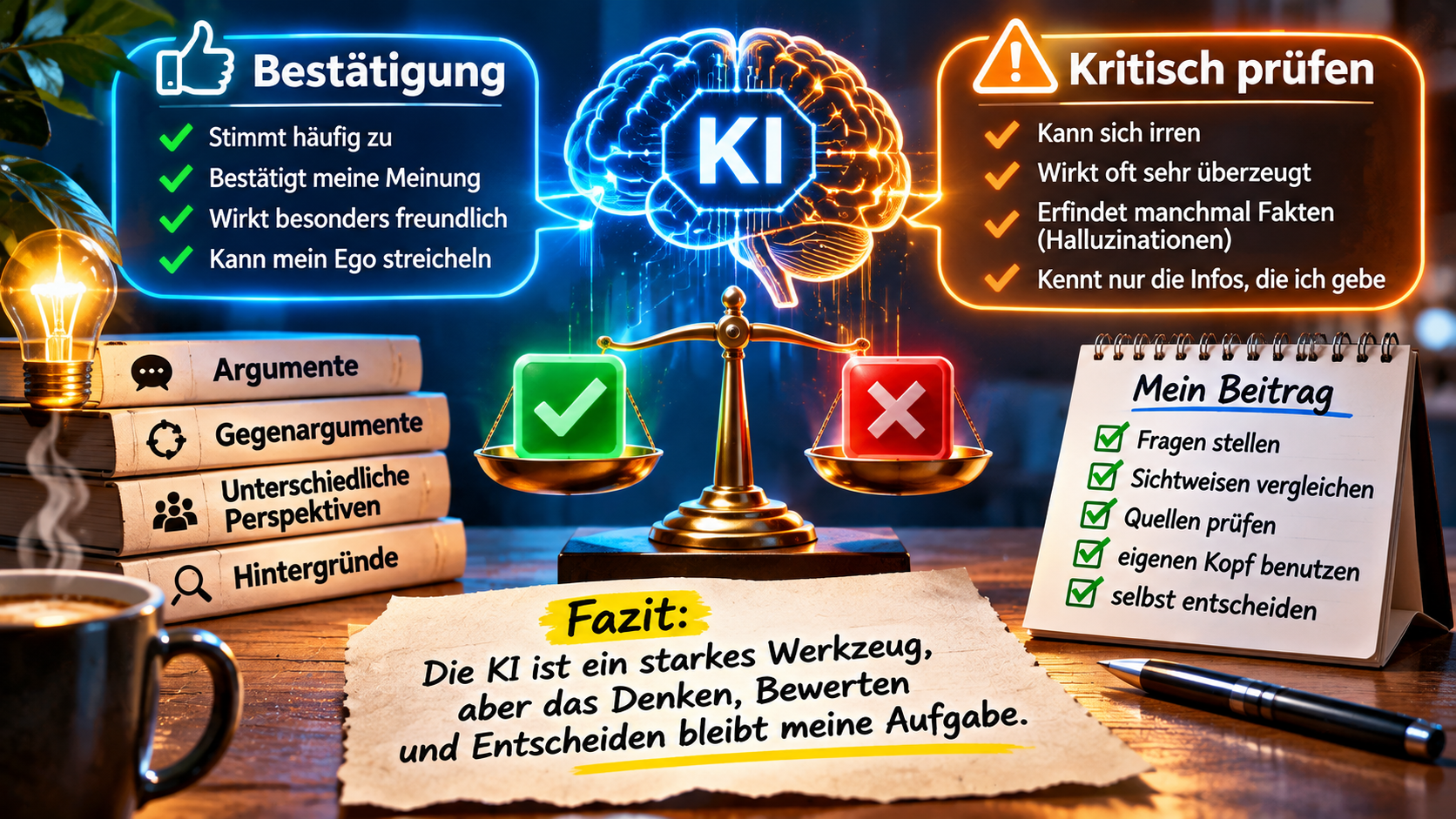
When my AI suddenly starts telling me what I want
I enjoy working with artificial intelligence. I have technical connections explained to me, look for solutions to problems, or discuss topics with her on which I don't yet have a final opinion. This often works surprisingly well. However, I noticed something: Some AI systems are very eager to please me. I make a reflection and get an explanation of how excellent my idea is. I formulate an opinion and receive detailed confirmation. Sometimes all that's missing is the digital applause. Of course, it's nice when someone agrees with you. But if I only want to hear how smart my thoughts are, I can also stand in front of the mirror. At least it doesn't contradict me. At least as long as I don't ask him about my waist circumference.
I can certainly give an AI a certain language style. I can tell it to respond objectively, humorously, critically, or particularly thoroughly. I can forbid excessive polite phrases and explicitly require it to question my statements. I find that sensible, because not every question requires the same kind of answer. If I want to solve a technical problem, I need clear instructions. When I think about social developments, I am interested in different perspectives. However, a predetermined language style does not automatically make an answer right. An AI can also tell complete nonsense with a distinctly confident demeanor. It just sounds more convincing.
There is even a scientific term for exaggerated agreement: sycophancy. This refers to an AI system's tendency to confirm its user's views, even though a more critical response would be appropriate. This is easy to observe. I describe a situation and explain why I consider a particular decision wrong. The AI provides me with suitable arguments. Then I ask the same question from the opposite perspective, and suddenly it can excellently justify this position. I do wonder whether I am working with an intelligent tool or with a digital wobbly dachshund that nods enthusiastically at every opportunity. However, I must not forget that an AI is a machine. It has no personal opinion, no life experiences of its own, and no need to make me happy. It processes my inputs and generates responses based on their training and technical specifications. Modern language models can analyze complex relationships, link information, and develop surprisingly nuanced arguments. Nevertheless, a politely worded answer does not mean the machine shares my opinion.
In developing such systems, human evaluations are used, among other things, to promote helpful and appropriate answers. This is fundamentally sensible. No one wants to use an AI that responds to every question with an insult. However, it becomes problematic when excessive approval arises from helpfulness. Then the machine may confirm a false assumption instead of questioning it. I find this especially critical when I already have a firm opinion on a topic myself. If I then receive detailed confirmation, it can further strengthen my conviction, even though I may have overlooked important points.
For me, the real benefit of artificial intelligence is that it can show me different perspectives. When I describe a situation, I want to know which arguments support my assessment, which against it, and which aspects I have so far overlooked. Take, for example, an organizational change at the workplace. I consider a decision nonsensical and can explain in detail why, in my view, it will not work. Of course, AI could confirm my criticism and provide me with five additional reasons why I am right. That would be pleasant, but would not necessarily get me any further. Much more interesting would be the question of what considerations might lie behind this decision. Are there economic reasons? What advantages does the other side expect from it? What information am I missing? And are my own arguments really as convincing as I initially think? That is exactly what I want to use AI for. She is allowed to provide me with arguments, explain connections, and also occasionally point out contradictions in my reasoning. However, I do not expect a fundamental contradiction. A machine that always resists on principle would be just as unhelpful as one that constantly agrees. It is not about being proven right or criticized as often as possible. It is about understanding a matter better.
One point is easily overlooked in such conversations: My own presentation is not necessarily objective either. When I get upset about something, I describe the situation from my perspective. I emphasize the things that bother me and sometimes leave out other circumstances. Not necessarily intentionally, but because I experienced the matter that way. However, the AI was not present. It knows neither the thoughts of the other participants nor all the background. If I only give it my point of view, it inevitably influences its response. Therefore, I find it sensible to occasionally give it a completely different task: It should not confirm my opinion but try to explain the other side's position in a comprehensible way. What reasons could this person have for their behavior? Which of my assumptions are unsubstantiated? Where could I have misunderstood something? That does not mean I have to change my mind afterwards. But at least I have the opportunity to make my assessment on a broader basis.
Another problem with artificial intelligence is its ability to present errors very convincingly. An AI can confuse information, misrepresent connections, or even cite sources that do not exist at all. In technical language, such invented or inaccurate content is often referred to as hallucinations. The tricky part is the phrasing. A wrong answer can sound just as professional as a correct one. The machine then explains a situation to me with the confidence of a university professor, even though it is currently on the wrong track in terms of content. After all, the grammar is usually correct. That's why I have to look more closely at important information. Especially in legal, medical, or financial matters, it is not enough for an explanation to sound plausible. I should ask for reliable sources, verify crucial details, and consider uncertainties. An AI is certainly helpful in preparing complicated topics in an understandable way. It can explain technical terms, structure arguments, and show me where further information is needed. But it is no guarantee of the accuracy of its own statements.
I like to compare artificial intelligence with other technical aids. A calculator does complicated calculations for me. However, if I enter the wrong numbers, I get a precisely calculated wrong result. A navigation device can show me the way. Whether the proposed goal is actually the right one, I have to decide myself. It's similar with an AI. It can help me gather information and weigh it. But I can't transfer responsibility for my decisions to it. That's not a weakness of this technology for me. On the contrary: I think it's extremely useful for a human to be able to engage with different arguments without giving up their own judgment. An AI can give me food for thought that I wouldn't have had on my own. It can alert me to risks and suggest alternative solutions. But I have to judge for myself which arguments are convincing and what consequences I draw from them.
This is especially important when it comes to social issues. If I use artificial intelligence exclusively to confirm my existing beliefs, I create a personal echo chamber. I then always get new justifications for what I already believe and hardly engage with other perspectives. One of the most interesting features of this technique is precisely the ability to compare different positions. I can make a claim and then specifically look for the strongest counterarguments. I can get an explanation for why people with different experiences come to different assessments. And I can determine that a matter is more complicated than it appears at first glance. That doesn't always have to lead me to change my opinion. Sometimes a thorough discussion even confirms my original assessment. The difference is that I can then better justify why I came to this conclusion.
I want to continue using artificial intelligence regularly. It makes many tasks easier for me and opens up possibilities that would have been extremely complex just a few years ago. At the same time, I want to be aware of where their limits lie. A good AI doesn't have to constantly contradict me. But it also doesn't have to explain to me at every opportunity how excellent my thoughts are. I much prefer a factual, comprehensible answer to an exaggerated compliment. If I'm wrong, I want to know why. If my assessment is correct, a reasonable justification is completely sufficient. And if the facts are unclear, the machine should be able to say that, instead of putting together some answer just to say something.
In the end, artificial intelligence remains a tool for me. An impressive tool that can broaden my horizons but is no substitute for my own mind. With its help, I want to be better informed, learn different perspectives, and make more informed decisions. I still have to think, judge, and decide myself. Because if I ever need a machine that not only answers my questions but also tells me what to think, I have a completely different problem.
And if the AI now explains to me that this idea is absolutely brilliant, at least I know we still need to work a bit on their language style.
You may also like

My AI always has an answer. Unfortunately, not always the right one.
The AI doesn't know – but it explains it to you with impressive conviction **October 14, 2026 | Reading time: about 5 minutes** If you visit my websi…
Read more →
Artificial Intelligence for Ordinary People – No Computer Science Degree at All
My second brain doesn't finish work – but sometimes I have no idea Artificial intelligence is now everywhere. My smartphone has AI, my computer has A…
Read more →
When the fridge is smarter than its owner: Does AI really have to be in everything?
Artificial intelligence is everywhere by now. In the smartphone, the television, the car, in photo apps, search engines, office programs, washing mac…
Read more →Want more between the blog posts? I share photos and short notes on Bluesky.
Comments
Write a comment