

My AI always has an answer. Unfortunately, not always the right one.
The AI doesn't know – but it explains it to you with impressive conviction
**October 14, 2026 | Reading time: about 5 minutes**
If you visit my website regularly, you may have noticed that something is always changing here. Sometimes there is a new function, sometimes the design is revised, and sometimes I struggle with a technical problem in the background that my visitors hopefully don't notice at all. After all, I run this website alongside my normal professional life and have neither my own IT department nor a programmer chained to the basement. The latter would probably violate several labor law regulations anyway. So I use artificial intelligence to help me with technical development. It doesn't charge an hourly wage, no coffee and doesn't complain when I explain to her for the fifth time that a certain function still doesn't work. But it has other peculiarities.
Because as impressive as artificial intelligence has become, it has a capability that is otherwise more familiar from people who do not want to admit that they have no idea in a discussion: It can tell nonsense completely convincingly. And with a self-confidence that could make even the biggest regulars' table expert jealous.
Imagine you ask an AI for a scientific study. Within a few seconds, it provides you with the name of a scientist, a suitable study title, the year of publication and maybe even an internet address. Everything sounds serious, scientific and incredibly competent. Unfortunately, the study does not exist at all. Congratulations, you have just met a so-called AI hallucination. And no, the artificial intelligence has not drunk anything before. It manages to do it completely sober.
In AI systems, hallucination refers to information that is false, inaccurate or completely invented. Not even the entire answer has to be wrong. Sometimes nine out of ten information is correct, while the tenth is fictitious. This is about as if a news anchor were to first report correctly about the weather, the economy and the traffic situation, and then explain as a matter of course that a parking fee for the moon will be introduced from next week. And because the man is wearing a suit and looks serious, the first viewers are already looking for the responsible parking machine.
Why does something like this happen? Modern language models have been trained with huge amounts of text and have learned to recognize linguistic and content-related relationships. Put simply, they calculate which formulations are likely to fit in a certain context. This works surprisingly well, but does not mean that every statement is automatically checked for accuracy. An AI can therefore produce a wonderfully formulated text that is about as reliable in terms of content as a weather forecast for Christmas 2047.
A study from 2025 shows how problematic this can be. Scientists reviewed 400 references that had been created by eight different AI chatbots. Only 26.5 percent were completely correct. Another 33.8 percent contained partially correct information, while around 39.8 percent were incorrect or completely invented. Of course, this does not mean that so many AI answers are fundamentally wrong. A very specific task was examined. Nevertheless, the result is remarkable. If you have scientific sources compiled by an AI, it is better to check afterwards whether the scientists mentioned and their publications actually exist. Otherwise, you will end up quoting Professor Doctor Fantasius from the University of Entenhausen.
With some topics, you can laugh at such mistakes. If an AI claims that an actor has starred in a film even though he has never been seen there, this is usually not the end of the world. The situation is different with medical, legal or financial issues. An overlooked interaction between medications, an incorrect legal deadline or an invented legal basis can have serious consequences. It doesn't help much if the answer is formulated in a particularly friendly way. After all, wrong medical advice doesn't get better because there's a smiley at the end.
Another point that I find important is data protection. Many people now treat AI systems like personal confidants. Private messages, medical documents, business documents and sometimes presumably the secrets of the mother-in-law are copied into a chat window. The main thing is that AI can help. You should be aware that entered information can be stored, processed or used to improve the systems under certain conditions, depending on the provider, tariff and settings. A friendly chatbot is not a confessional with a Wi-Fi connection.
You have to be careful, especially when it comes to technical work. If I have an error message or program code examined, I should first check whether it contains passwords, access keys or personal data. Such information does not belong unchecked in any AI service. After all, I wouldn't hang my front door key on a balloon and hope that no one will find it.
Nevertheless, AI is an extremely practical support for my own website. It can help me to track down errors in the program code, to further develop functions, to improve the design or to identify possible security gaps. I find such possibilities particularly interesting when it comes to protection against hacker attacks. After all, I don't want to find out one morning that my website suddenly advertises dubious cryptocurrencies, counterfeit luxury watches or some miracle cure that supposedly solves all the problems of the human body within three days.
However, the use of AI does not mean that I blindly accept their suggestions. It can also make mistakes when programming. Therefore, changes must be checked and tested. A security measure that keeps all hackers away, but at the same time locks out all normal visitors, would perhaps be logical from a technical point of view, but rather unfavorable for a website. That would be about as if you were to demolish your own house to protect yourself from burglars. Problem solved, living comfort manageable.
I draw a clear line when it comes to the content of my website anyway: I am responsible for what is published here. The topics, my thoughts, my experiences and my personal attitude come from me. AI can help me with research, explain complicated relationships or suggest linguistic improvements. But it has not made my experiences and does not decide what I think. When I write about alcohol, social issues or experiences from my everyday life, my point of view should be recognizable. And if a mistake should creep in, I can hardly claim that artificial intelligence is to blame and is unfortunately on vacation right now.
That's why I don't think it's fundamentally reprehensible to use modern tools when writing or designing. After all, a photographer doesn't become superfluous because his camera focuses automatically. And no one would think of accusing a craftsman of using a cordless screwdriver instead of turning every screw into the wall with his bare fingers. The decisive factor is who makes the decisions, controls the result and takes responsibility for it. However, an honest approach to how much support was actually used is also part of it.
My conclusion:
Artificial intelligence is a helpful tool for me, but not a digital omniscient that I blindly trust. It can technically improve my website, relieve me of work and open up new possibilities. At the same time, it can invent information, overlook errors and become a data protection risk if used carelessly. That's why I control important results and keep the decisions in my own hands. The AI is welcome to think, but it is not given responsibility.
What I would particularly like to see from future AI systems is a better way of dealing with uncertainty. I would sometimes prefer a machine that reliably says "I don't know" to one that produces three pages of perfectly formulated nonsense.
And if an artificial intelligence should at some point explain to me that it basically no longer makes mistakes, I will become particularly suspicious. After all, I already know such statements from humans. Usually shortly before anything has gone fundamentally wrong.
Freric
You may also like

Artificial Intelligence for Ordinary People – No Computer Science Degree at All
My second brain doesn't finish work – but sometimes I have no idea Artificial intelligence is now everywhere. My smartphone has AI, my computer has A…
Read more →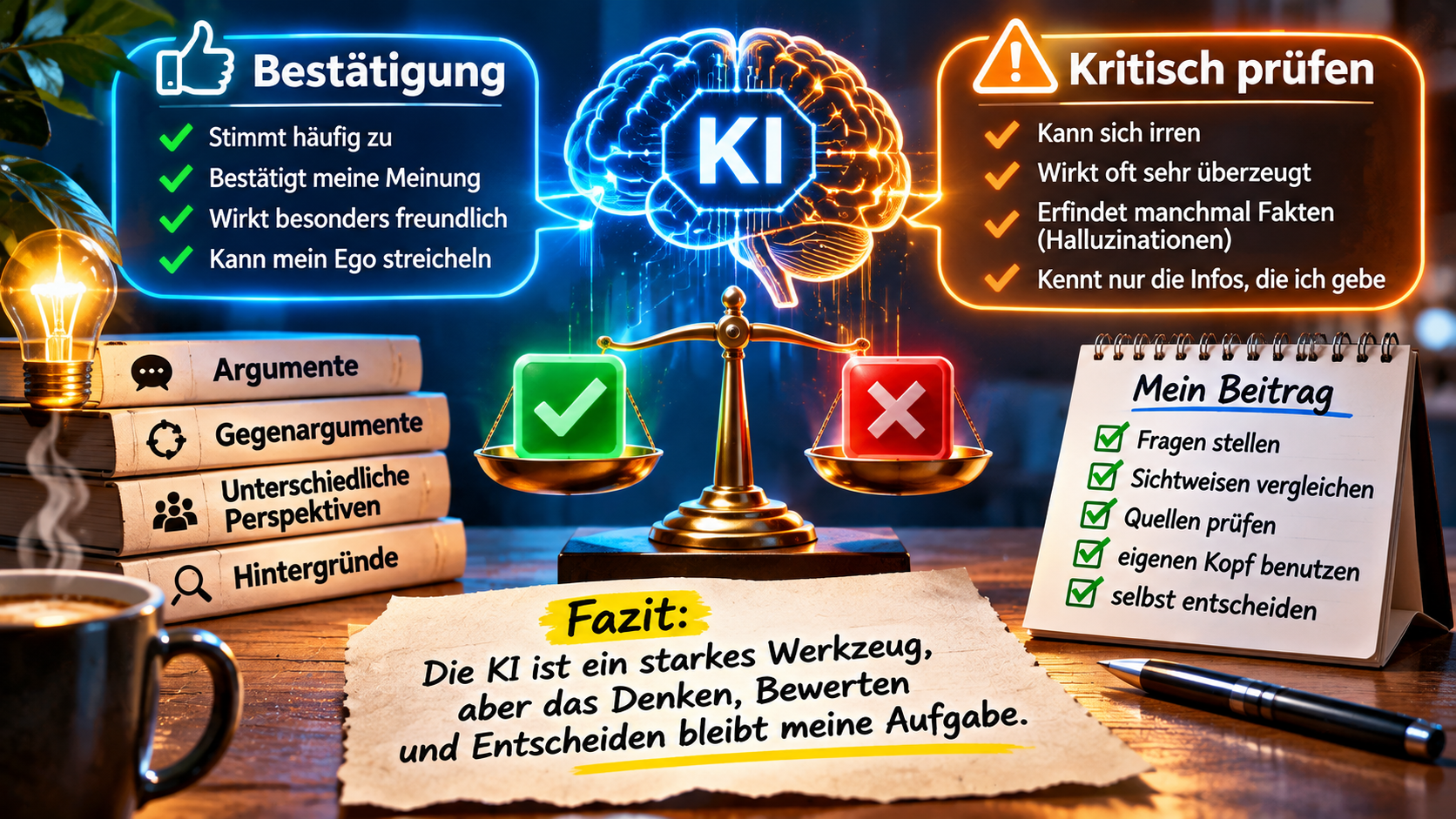
When my AI suddenly starts telling me what I want
I enjoy working with artificial intelligence. I have technical connections explained to me, look for solutions to problems, or discuss topics with he…
Read more →
No more capital letters, special characters, and password confusion
The password can be retired. I will not cry after him. Why I consider Passkeys to be one of the most meaningful developments in digital security and …
Read more →Want more between the blog posts? I share photos and short notes on Bluesky.
Comments
Write a comment