
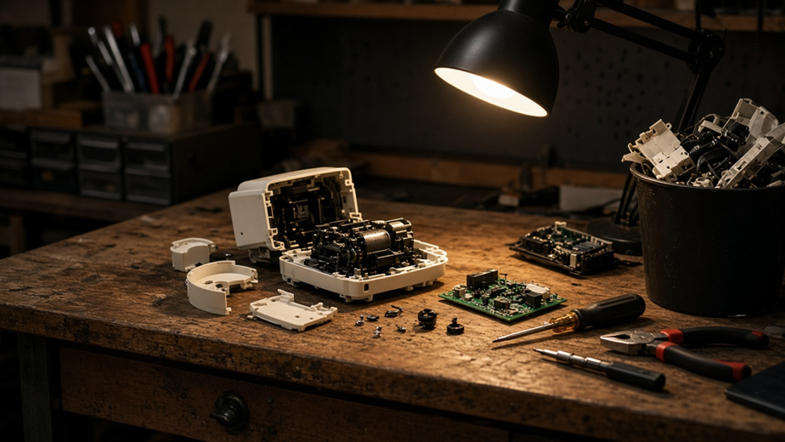
Why repairs are often more expensive than new devices today
I grew up with a time when "broken" did not automatically mean: get rid of it. When the TV was no longer running, the first thing to do was to look at what was wrong. If the washing machine made noises that sounded more like a concrete mixer than a spin cycle, a new one was not immediately ordered. Someone knew someone who "knows about something like that". And surprisingly, the device often actually worked again afterwards.
Today it's different. When something breaks, I catch myself more and more often asking myself: Is a repair still worth it? And that's exactly the crazy thing about it for me. Not necessarily that we have all suddenly become a throwaway society, but that repairing often simply no longer makes economic sense.
Let's take a kettle for 35 euros. If I take it to a specialist workshop and the working time alone costs more than a new appliance, the decision has actually been made. The situation is similar with headphones, small kitchen appliances or other electronics. I can think sustainably – if a repair costs me 90 euros and a new appliance 50 euros, then I must have developed a lot of love for my old toaster.
It gets more complicated with larger devices. A washing machine, a TV, a smartphone or a tablet cost significantly more. Nevertheless, you are quickly faced with absurd repair prices. Display broken? Battery defective? Charging socket over? PCB defective? Sometimes you get a cost estimate and ask yourself briefly whether the price for half a new device has not accidentally slipped below.
I definitely like technology. I'm interested in new devices, like to try things out and usually want to know what a device can do. But that doesn't mean that I can repair it. My areas of expertise are simply somewhere else. Just because I like to work with technology doesn't automatically mean that I measure a circuit board, disassemble a TV or change the battery of a smartphone. After all, I can also drive a car without being able to take the gearbox apart.
And that's exactly where the problem begins for many people. Even if you were basically willing to have something repaired, you are often dependent on professionals. This is completely normal. Nobody can do everything. But it becomes difficult when there are hardly any repair shops, spare parts are difficult to obtain or the repair is so expensive in the end that the new device next to it suddenly looks like a bargain.
What also bothers me is that many modern devices are no longer built at all so that a normal person can open them properly. In the past, you had screws. Today you have glue. A lot of glue. And if you do find a screw, you might need a special bit, which probably only three people in Europe have.
That's why I wouldn't even try to lend a hand to some devices myself. Not out of fear, but out of a healthy instinct for self-preservation. You start with a small defect and two hours later you sit in front of twelve screws, three cables, a housing part and the question of why there are actually two parts left. At the latest then you know: Maybe that wasn't my area of expertise after all.
In the past, people also often had the feeling that devices were built for longer use. Today, they are often much better technically, but at the same time sometimes more difficult to repair. That's actually a strange contradiction. Today, we can do things with a smartphone that would have taken several devices in the past. But if the battery runs out after a few years, a small wearing part can suddenly turn into a major operation.
And this brings us to the real problem for me: Not everything that is exchanged really needs to be replaced.
A battery is a wearing part. A switch can break. A cable can break. A socket can wear out. These are not extraordinary disasters, but things that happen at some point with regular use. Actually, it would be logical to be able to change such parts as easily as possible.
That's why I think the idea of repair cafés is pretty good. People bring defective devices there and try to get them working again together with people who are familiar with it. That's exactly where the advantage lies for me: You don't have to be the big electronics expert yourself. Sometimes you just need someone who knows where to look.
Of course, this doesn't always work. Sometimes dead is actually dead. But at least it is checked beforehand whether the device is really scrap or whether just some small part refuses to work.
I also think the idea behind the right to repair is basically right. If I buy a device, I should at least have a reasonable chance of using it for a few years and having it repaired in the event of a defect. For me, this includes spare parts, comprehensible designs and repair options at prices where you don't automatically reach for a new device.
Of course, this should not be romanticized. Not every repair makes sense. If a very old refrigerator consumes vast amounts of electricity, replacing it may be more reasonable. If an appliance is technically completely outdated and hardly supported, there is also no point in compulsively keeping every part alive. You have to compare.
That's exactly what I'm doing more and more often. How old is the device? How much does the repair cost? How much does a new one cost? How much energy does it consume? Are there spare parts? And above all: Is there anyone who can repair it properly?
Because just because I like technology doesn't mean that I can repair it. My strengths lie elsewhere, and that's perfectly fine. That's exactly why it would be all the better if repairing became easier, more accessible and more economically sensible again.
Sometimes it turns out that repairs are worth it.
Sometimes it comes out: Get rid of it.
What I find a pity, however, is this automatic reflex to immediately look for a new model every time there is a defect. Because sometimes the whole device is not broken.
Sometimes all that's missing is a small part for five euros.
And if this small part is available and someone can be found who knows what to do with it, then the device can do its job with me for a few more years. In any case, I don't see why the entire device should go to electronic waste for a few euros because of a component. That would be about as if I were to dispose of my car just because the windshield wiper is broken.
Freric
You may also like
Bought is bought? Not if the manufacturer still wants to make a profit.
Purchased, paid, and yet not my property? Welcome to digital serfdom I love technology. That probably isn't much of a secret anymore. When a new devi…
Read more →
Not all USB-C is the same – why the same cable can suddenly do completely different things
Actually, USB-C should make a lot of things easier. A plug for smartphone, tablet, laptop, headphones, power bank, monitor and now everything that ne…
Read more →
Why is our electricity so expensive in Germany? Despite wind and sun?
Sun and wind don't send a bill – why is our electricity still so expensive? When I look around Germany, I see solar systems on more and more roofs. T…
Read more →Want more between the blog posts? I share photos and short notes on Bluesky.
Comments
Write a comment