
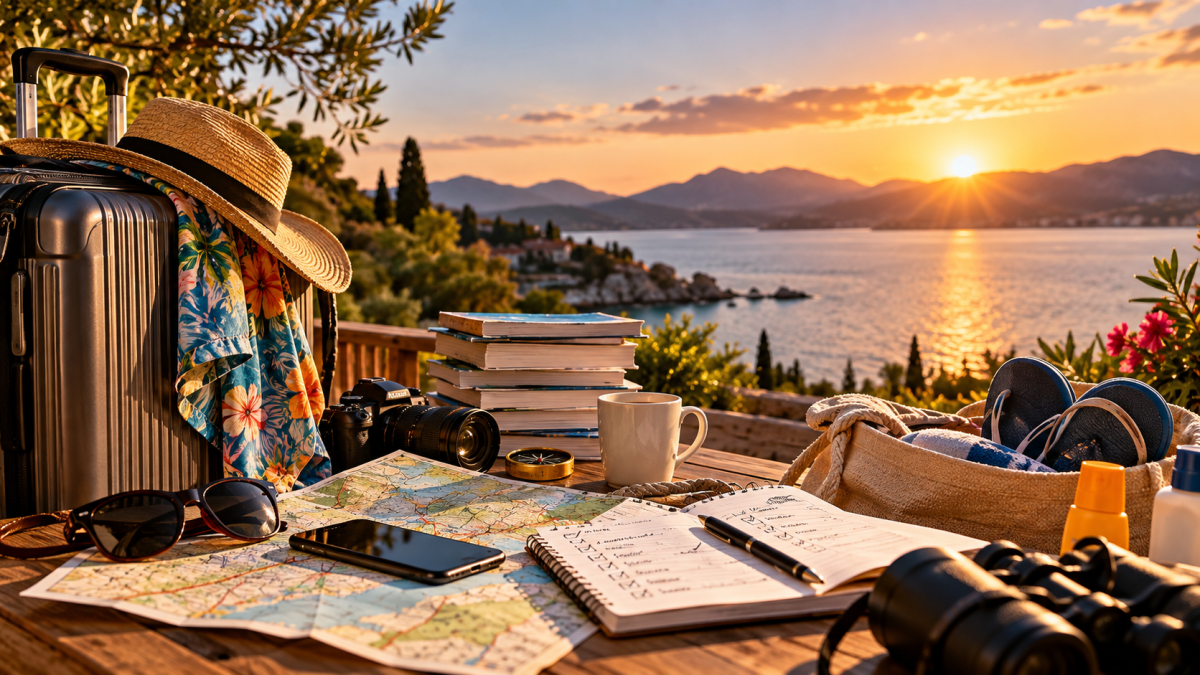
Who doesn't know it? Holidays with to-do lists.
Not all vacations are the same. At first, this sounds like one of those pieces of wisdom that you could print on a mug, right next to "Carpe Diem" and "Live, love, laugh". In fact, however, there are a surprising number of types of vacation. Vacation, educational leave, special leave, parental leave, which used to be called child-rearing leave, unpaid leave and probably a few more variants where some HR department immediately comes around the corner with a form. So vacation is apparently a pretty versatile word. Only recovery sometimes works worst with the most well-known variant. Let's take the classic vacation. The name alone sounds wonderful: relaxation, rest, sleeping in, drinking coffee, just doing nothing for once. Maybe get up in the morning when your body thinks that the night has now lasted long enough, and not because some electronic device next to the bed suddenly sounds the alarm. Theoretically, at least. In practice, many people's vacations begin about three weeks in advance with planning that makes a minor military operation seem almost spontaneous. "When we have a vacation, we could finally ..." This sentence is dangerous. Really dangerous. Because behind this inconspicuous "finally" can hide things that have been waiting for their chance for months. The basement would have to be tidied up, the garage could be sorted, the garden also looks as if it has personal problems, a wall would have to be painted somewhere, the hedge could do with a cut, the shelf, which has been in the basement in its original packaging since November, could be set up, and in addition, people have long wanted to sort the documents, back up the photos, clean up the hard drive, clean the car thoroughly and clean out this one drawer, which can now only be closed by using your own body weight. And suddenly there is no longer "vacation" in the calendar, but a to-do list that even a project manager could get nervous at the sight of.
Of course, you also want to experience something on vacation. After all, it would be downright negligent to just lie around on the sofa. After all, you're free. So a day trip is planned. Maybe a second one. Then you could finally visit friends you've been putting off for months. Your relatives would also be happy if you showed up. And because you're on the road anyway, you could quickly go shopping somewhere afterwards. By the way, "fast" is one of those words that regularly loses its meaning in connection with vacation. A leisurely excursion quickly turns into a daily program. Breakfast at nine, departure at ten, looking for a parking space at eleven, sight number one, lunch, sight number two, coffee, a quick somewhere in, shopping on the way back and back home at eight in the evening. There you fall exhausted on the sofa and say the sentence that people on a relaxing vacation apparently say surprisingly often: "But tomorrow we're really not going to do anything." That's usually a lie. The next morning, someone remembers that you have time after all. Time is apparently a natural enemy of idleness on vacation. As soon as a free afternoon appears somewhere, it has to be filled. It seems almost socially suspicious when someone simply answers the question "What did you do on vacation?": "Nothing." Nothing? Nothing at all? Didn't go away? Didn't hike? No sights? No day trip? No bike tour? Haven't been at least somewhere? No. Just nothing. Actually, that should be exactly the most impressive answer ever. Ignored appointments for two weeks, didn't look at the clock, drank coffee in the morning, sat around in the afternoon and thought in between about whether it was worth putting on pants at all. That would be consistent relaxation. Instead, after the holiday, we tell each other about 1.800 kilometres driven, seven cities visited, three hikes, four restaurant visits and an amusement park and then wonder why we look like we have crossed the Alps on foot on our first day at work.
Of course, there are also vacations that have little to do with classic recreation in principle. Educational leave, for example. You have time off from normal work, but you are specifically involved in further education. That can be meaningful, interesting and even really good. Only anyone who talks about having had a week's vacation afterwards could evoke completely wrong ideas in their fellow human beings. You didn't lie by the pool with a cocktail, but possibly eight hours a day in a seminar room and dealt with labor law, communication, politics, languages or other topics. Afterwards you may be smarter, but possibly also more tired. Then there is special leave. Even the name sounds a bit exclusive, as if someone somewhere would open the golden door to a particularly luxurious vacation. In fact, these are often special personal occasions such as wedding, birth, death or other situations in which you are released from work. This usually has little to do with vacation in the sense of putting your feet up. And then, of course, there is what used to be often called child-rearing leave and is now called parental leave. Anyone who has ever experienced small children, however, knows that the word "vacation" at this point shows a remarkable sense of humor anyway. Vacation usually means sleeping in. However, small children often interpret sleeping in as "until 6:17 a.m." You have time off from work and instead work in a completely new company called family, with flexible working hours from about 0 to 24 hours and a management that regularly yells if it doesn't like the corporate strategy. Unpaid vacation, on the other hand, is particularly interesting. You actually get time off, but you don't get any money for it. Basically, you buy your own free time. Also a concept that only humans could invent.
But back to the relaxing holiday, because that's exactly what concerns me the most. I think that we have sometimes developed a completely absurd relationship with relaxation. Even if we don't have to do anything officially, we manage to voluntarily put together a programme that almost reminds us of a working day. The main difference is that there is no time clock next to it. You might even drive away properly. A week in a hotel, holiday apartment or campsite. Sounds like maximum relaxation at first. But the big holiday ritual begins as soon as you arrive. Pack your suitcase. Do I have the toothbrush? Charging cable? Medication? Underwear? Swimming trunks? Papers? Are the windows closed? Is the stove off? Have I really checked the stove? Maybe it's better to go back again. Then it starts. Traffic jam. Construction site. Another traffic jam. The navigation system suggests a "faster route", on which you are on a road after twenty minutes, which was probably last used by a tractor. At some point you arrive, lug luggage into your room and need half a day to recover from the fact that you went on vacation. Afterwards, of course, you want to see something of the area. After all, that's what you're there for. So the program starts again: sights, excursions, restaurants, museums, beach, city center, viewpoint and definitely this insider tip from the Internet, which apparently 4.000 other people have read at the same time. And at some point, usually about two days before you go home again, something strange happens: You start to relax. The body slowly understands that no alarm clock rings in the morning. The head stops thinking about work all the time. You sit somewhere, just look around and think: Actually, I could do this more often. And just at that moment, someone looks at the calendar and says: "The day after tomorrow we have to go home again." Perfect timing.
When you get home, the next phase of your vacation begins: unpacking your suitcase, doing your laundry, doing the shopping, checking the mail and somehow finding your way back into the normal rhythm. On the last day of your vacation, of course, you resolve to take it easy. Instead, at some point you stand between the washing machine, shopping bags and half-unpacked suitcase and ask yourself how exactly this relaxation was actually intended. The next morning, the alarm clock rings. And then something happens that everyone has probably experienced before. You're sitting at work, someone asks friendly: "Well, well rested?" And you briefly consider whether you should laugh or cry. Of course the vacation was nice. Of course, excursions were nice. Of course, it's nice to do things for which there is otherwise no time. And of course, I don't want to spend my vacation motionless on a chair for two weeks. But maybe it wouldn't be a bad idea to take the term vacation a little more literally from time to time. Not every day off has to be productive. Not every afternoon needs a program. Not every free hour has to be used wisely. You can also dawdle around once in a while. You can drink a second cup of coffee in the morning even though weeds are growing somewhere outside. You can waste an afternoon. You can even lie on the sofa and achieve absolutely nothing. The universe will be able to cope with it.
Maybe the perfect vacation in the end would even be the one you can't talk about very much afterwards. "And? What did you do?" – "Not much." – "And how was it?" – "Great." Because strictly speaking, I regularly need a whole new vacation category after my vacation: vacation from vacation. A week without sights, without projects, without excursions, without basement, without garden and, if possible, without the sentence "Now that we have time, we could ..." Just free. That would be a relaxing vacation.
Freric
You may also like
A new week begins
A good week doesn't start with perfection A new week lies ahead of you. Five, six, or seven days during which a lot will happen again: work, appointm…
Read more →
The day is over – you don't have to take him to bed
Some days still linger in the evening, even though it could have ended long ago. Maybe there was a silly remark at work, an appointment that didn't g…
Read more →
We're fine, aren't we?
As some of you have noticed by now, I work exclusively at night. Since I work in the newspaper printing department of a national daily newspaper, thi…
Read more →Want more between the blog posts? I share photos and short notes on Bluesky.
Comments
Write a comment