
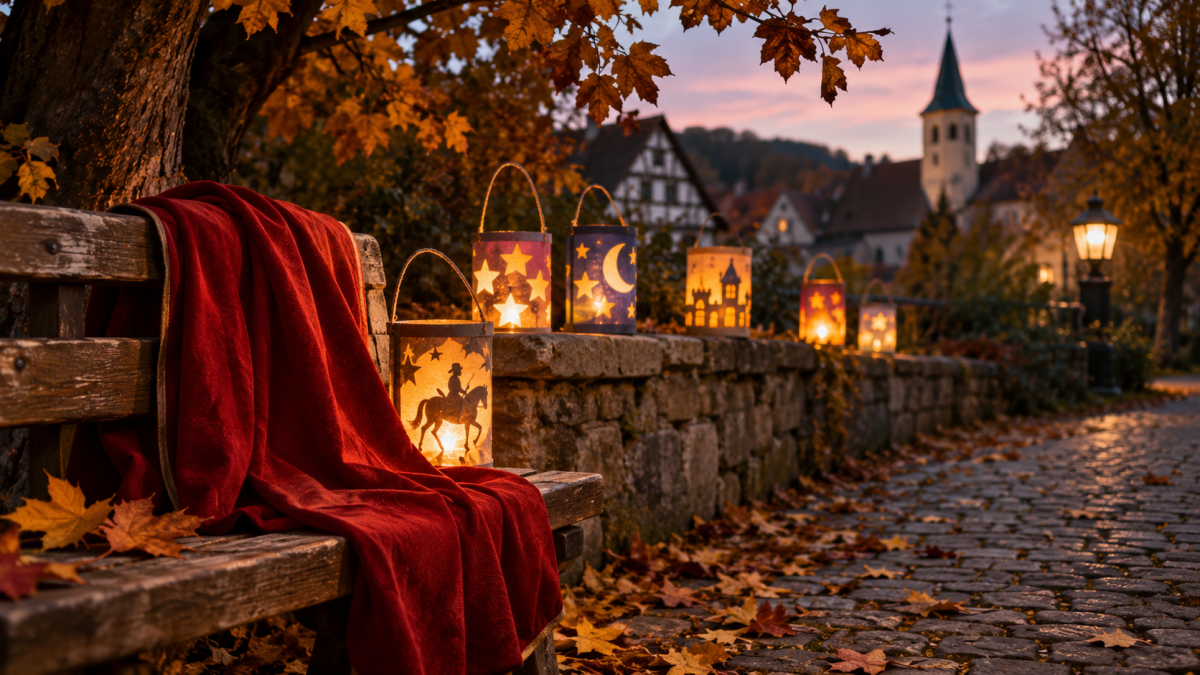
Saint Martin or Festival of Lights – do we really need to rename our traditions?
These days, children are once again parading through the streets with their homemade lanterns, singing songs and looking forward to the cozy get-together. What is traditionally called the Martin parade or St. Martin's festival in many places is sometimes also called the Lantern Festival or Festival of Lights. And that's exactly what I have been thinking about. Do we really have to make our traditional festivals increasingly neutral so that no one in our diverse society feels excluded?
Let me make one thing clear right away: I have absolutely no problem with people of different religions, cultures, and worldviews living together. Everyone should practice their faith, maintain their traditions, or be able to live entirely without religion. But for me, tolerance does not mean that we have to rename our own traditions as a precaution. Rather, we should learn to respect differences and interact with each other.
What Saint Martin Really Is Behind
The story is probably familiar to most. Martin of Tours was a Roman soldier in the fourth century and later became a bishop. According to tradition, he met a freezing beggar, shared his cloak with the sword, and gave him half. A simple act whose significance remains understandable to this day.
Martin saw a person in distress and helped him. He did not ask about his origin, religion, or social status. He also did not give a lecture about how the man should have prepared better for winter. He simply acted. Although I must admit that a Roman soldier who quickly worked on his cloak with a sword would probably today first spark a discussion about property damage.
Of course, this story is shaped by Christianity. But compassion, helpfulness, and the willingness to share are not exclusively Christian values. They are found in many religions and also among people who do not belong to any religious community. That is precisely why I find the story of Saint Martin so fitting for our society today.
Why the St. Martin's Festival Becomes a Festival of Lights
One should first distinguish: A traditional St. Martin's parade explicitly commemorates Martin of Tours. A lantern or light festival, on the other hand, can also be celebrated independently of this religious history. Some kindergartens and institutions deliberately choose a neutral name to appeal to families with different religious backgrounds.
I can certainly understand that. No one should feel excluded. However, I wonder why the story of a man who helped someone in need should even be considered an obstacle to a shared celebration.
I do not want to claim that St. Martin's festivals are being renamed everywhere. Many events still carry their traditional names. Rather, I am concerned with the fundamental question of whether we really need to neutralize cultural and religious traditions in order to show openness.
Diversity does not mean making everything equal
Our children today grow up with people of different religions and cultures. I think it's important that they get to know their customs and understand what lies behind them. But of course, this should also apply to the traditions that have shaped our society for centuries.
I don't have to be Muslim to be interested in Ramadan, nor Jewish to want to learn anything about Hanukkah. Nor does anyone have to be Christian to understand the story of Saint Martin or to participate in a St. Martin's procession.
For me, true tolerance means respecting other people's beliefs without having to hide your own. No one should be pressured to attend a religious event. But just as little should a traditional name automatically be understood as exclusion.
Children in particular can learn that different faiths coexist and still convey common values. For that, we need to explain the background to them, instead of simply leaving them out.
What we should really pass on to our children
When I think of a St. Martin's parade, I mainly see children with glowing lanterns looking forward to a nice evening. Most probably worry less about religious terms and more about whether their lantern will hold up and what will be eaten afterwards.
But exactly such events offer the opportunity to convey something important. After all, sharing means more than just occasionally giving your best friend a gummy bear. Although for some children, that may already be a considerable sacrifice.
It's about caring for other people, helping them, and sometimes giving something away without expecting anything in return. This message can be conveyed wonderfully without a child having to belong to a particular religion.
For me, Saint Martin can remain Saint Martin
I have no objection to institutions organizing an independent Festival of Lights. Traditions change, and joint celebrations can be organized differently. But if the story of Saint Martin is explicitly at the center, I see no reason to avoid his name.
We should not preemptively assume that people of other faiths will take offense at our traditions. It would be more sensible to talk to each other and promote mutual understanding.
I want to live in a society where different religions, cultures, and worldviews have their place. For me, this also means that we can continue to call traditional festivals by their name without devaluing or excluding anyone.
After all, the story of Saint Martin is not about which religion a person belongs to, but about how they treat others.
And if we want to take something from this festival for our everyday lives, we should argue less about whether it's called the Martinsfest or the Festival of Lights.
Much more important is whether we ourselves are still willing to share our coat.
You may also like

Everything used to be better – the rearview mirror is lying
Was everything better in the past? My rearview mirror sometimes tells me quite a bit of nonsense I now belong to the generation that occasionally say…
Read more →
Gay, lesbian, queer – why do people still have to fight for acceptance?
Love is not abnormal. Intolerance is. Sometimes I seriously wonder what century we are actually living in. It's the year 2026, sending people into sp…
Read more →
On October 3rd, everyone adds their mustard. Here's mine.
Day of German Unity – we are united. Or is it? On October 3, we celebrate the Day of German Unity again. Germany has been a country again for 36 year…
Read more →Want more between the blog posts? I share photos and short notes on Bluesky.
Comments
Write a comment