

Yes, no, maybe – the menu of pleasure
The Yes-No-Maybe-List is one of the most inconspicuous and at the same time most useful tools in BDSM. Why three columns reveal more about preferences and boundaries than any gut feeling.
When two people want to try BDSM together, an honest conversation about preferences and boundaries is more important to me than any rope and paddle. One tool that makes this conversation amazingly easy is the yes-no-maybe-maybe list. It looks like a form from the office, but it's more of a menu, and that's exactly what makes it so valuable.
What exactly is a Yes-No-Maybe-List? It refers to a long list of actions, roles, words, and situations that each person involved goes through and checks off on their own. "Yes" means: I would like to experience this. "No" means: That is out of the question for me. "Maybe" means: I want to talk about this; under certain conditions, I can imagine it. In English, the principle is known as the Yes, No, Maybe List . A widely used version comes from the American educational site Scarleteen, which, in addition to the three columns, even offers fields for "I don't know" and "only as a fantasy." In German-speaking countries, the term 'Tabuliste' is also common for something similar, but it only emphasizes the 'no' side. I find the look at all three columns more honest.
The list – not a contract, but a snapshot
Before we talk about the individual columns, we should clarify what the list is not. It is not a contract that someone signs and then enforces. It is also not an order that the other party has to process. A "yes" on paper does not automatically mean a "yes" on any given evening. Consensus, that is, the voluntary, informed, and revocable consent of all parties involved, always arises in the moment and not in the folder.
That's why I see the list as a snapshot. It shows where two people are currently standing, and it's allowed to change because people change. Anyone who fills out their list again after half a year will probably mark a few crosses elsewhere. That's not a contradiction, but a good sign. After all, I haven't ordered the same schnitzel in restaurants for decades.
The Yes Column – Wishes Need Words
At first glance, the Yes column seems the simplest, yet it is the hardest for many. Talking about what I wish for makes me vulnerable, because a wish can be ridiculed or rejected. The list takes a bit of pressure off there, because the cross ends up on paper first and only then in conversation.
For me, a simple rule applies: A yes is an invitation and not an obligation for the other. If something is in the yes column for me and in the no column for the other person, then the topic is settled for that constellation. There is no majority decision and no negotiation mass according to the motto "I'll go along with one if I get the other in return." Two yes votes make one possibility. A yes and a no results in a no. That's not higher math, even if some in the scene occasionally miscalculate.
The No column – an allergy is not a matter of taste
Anyone who, like me, has worked many years in restaurant service knows that there is a huge difference between "I don't really like that" and "That gives me an allergic shock." It's the same with the no column. A no is a hard boundary, often called a hard limit in the BDSM scene, literally a hard boundary. There is no negotiation, no joking, and above all, no "just testing whether it was really meant that way."
A no doesn't have to be justified either. Some boundaries have a story no one wants to tell, others are simply a matter of taste. I don't need to know the reason to respect it. No chef would "just a little bit" indulge a guest with a nut allergy to avoid making a fuss. Anyone who tries to do that with a boundary, in my view, hasn't understood what it's about.
The Maybe column – this is actually where negotiations take place
The most exciting for me is the middle column. A maybe usually means: under certain conditions, slowly, not at the first meeting, or only if I can get out at any time. In the scene, this is often called a soft limit , a soft boundary that can sometimes be shifted, but not from outside and not by pushing.
This is exactly where the conversation is worthwhile. What exactly does the 'Maybe' make? Is it the fear of pain, the worry of feeling ridiculous, or is it simply a lack of experience? Helpful are concrete sentences like "I can imagine shackles, but only at the wrists and only if I could free myself." Also important is the safeword, a pre-agreed word with which each person can immediately stop or interrupt the event. A 'Maybe without a safeword' is like a daily recommendation without a list of ingredients. It can work well, but it doesn't have to.
The conversation afterwards – the list is just the appetizer
The completed lists are not results, but the beginning. I think it makes sense to place them side by side calmly, preferably in daylight, dressed and without time pressure. Then it quickly becomes clear where two yeses meet, where there is a no, and where the 'maybe' fields need a more detailed conversation. And yes, that can feel quite sober at the kitchen table. But it is precisely this sobriety that creates the trust that later in the game.
For me, the Yes-No-Maybe list is not a romance killer, but a menu that both guests can read in peace beforehand. What do I want? What absolutely not? What maybe, if the conditions are right? Those who answer these three questions honestly and take each other's answers seriously have already done a lot right. The list does not replace asking questions during a session or paying attention to each other. It only ensures that no one has to order blindfolded. Paper creates clarity. Conversations build trust. And respect ensures that both hold.
Freric
You may also like

Why we so often misunderstand BDSM
A couple sits opposite each other at a wooden table and exchanges an attentive look. What looks like violence can be based on deep trust When people …
Read more →
Humiliation behind closed doors – words with boundaries
A stylized depiction shows a kneeling person touching another person's foot. Huge can be very pleasurable in BDSM, but only within a framework that s…
Read more →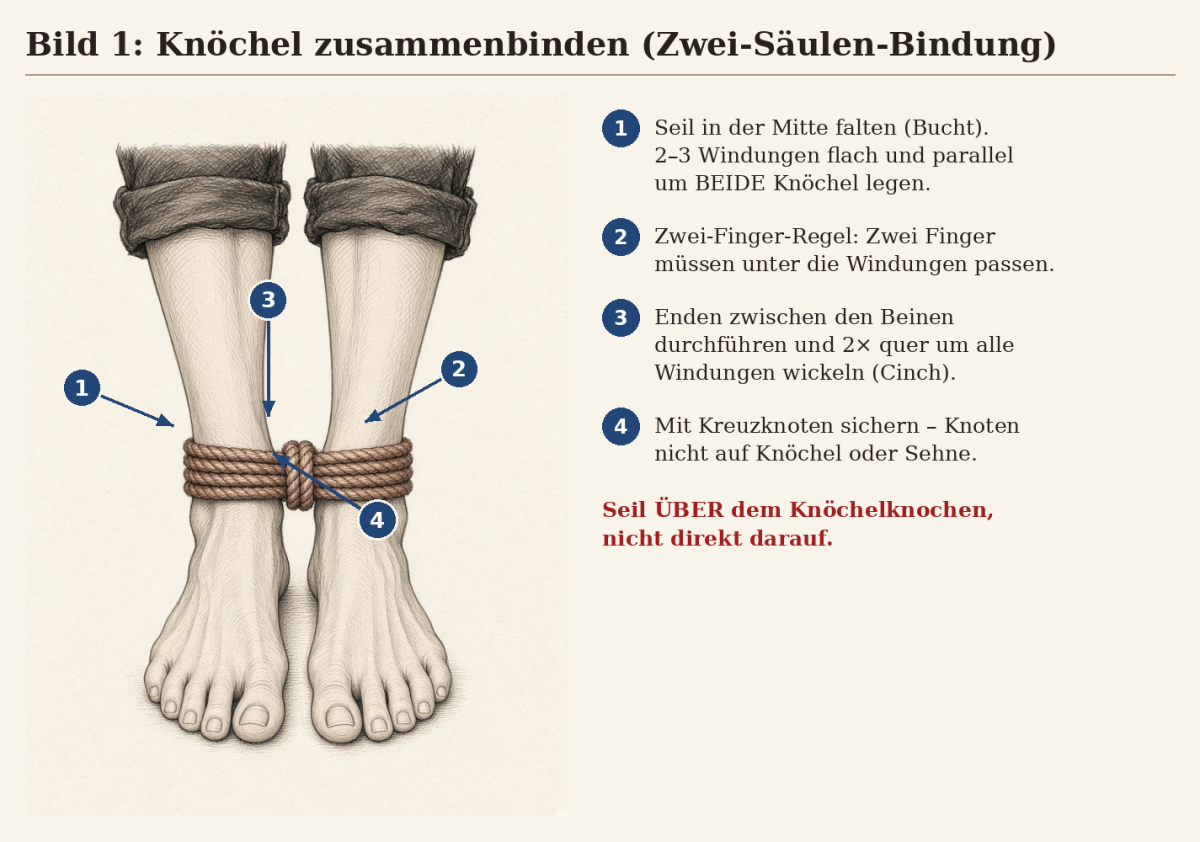
Bondage Without Rope: How Simple Bondages Work
When I think about bondage, I don't first see elaborate rope patterns in front of me. I think of tied hands, closed legs, and the trust someone place…
Read more →Want more between the blog posts? I share photos and short notes on Bluesky.
Comments
Write a comment