I have already written about impact play. At that time, I was mainly concerned with the basic attitude, trust, dedication, power and responsibility. Today I would like to be a little more practical. Because as nice as the theory is: At some point you stand there with a paddle in your hand and should know if possible what you are actually doing with it.
But first we should clarify what we are talking about in the first place. After all, this article should not only be understandable for people who have been in the BDSM scene for twenty years and immediately know which tool is meant when they hear the word flogger.
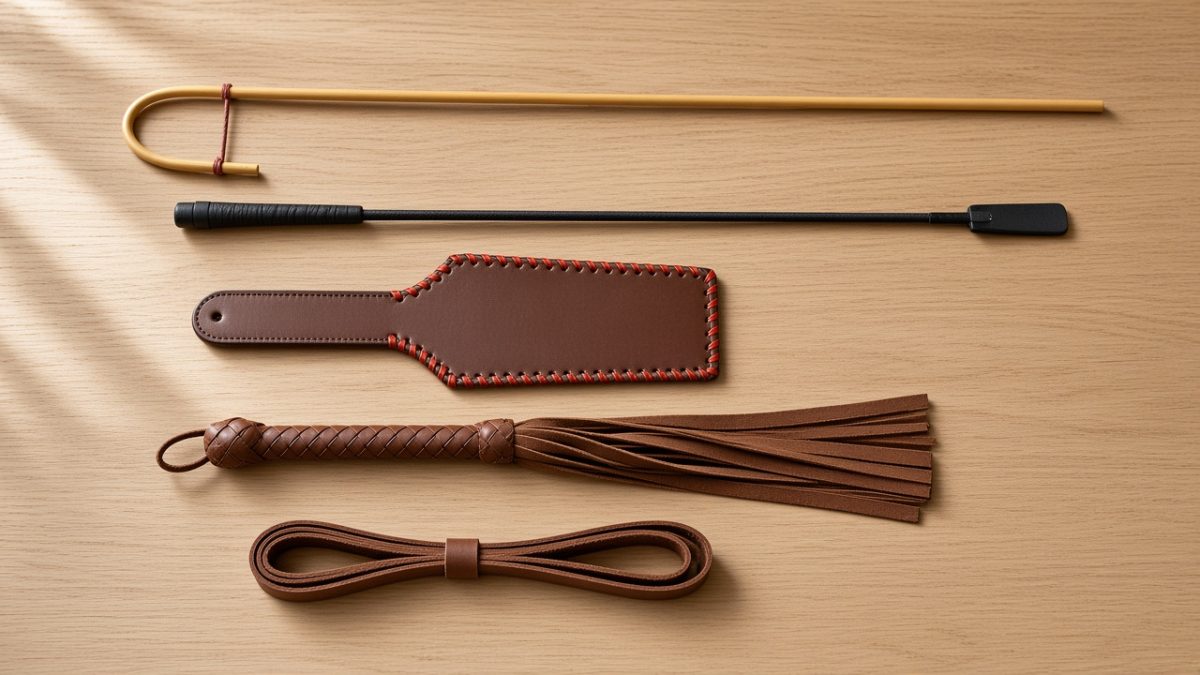
**What does impact play actually mean?** The term comes from English. "Impact" means impact, thrust or punch, while "play" stands for play. Loosely translated, one could therefore speak of a punching game. This refers to consensual practices within BDSM, in which stimuli are deliberately generated by punches or similar physical influences. These include, for example, spanking with the flat of the hand, but also the use of paddles, crops, floggers or canes.
And before anyone asks why you absolutely need an English term for it: I don't know that either. Probably "Impact Play" just sounds a bit more elegant than "Today we're dealing with the controlled spanking of adults". The BDSM scene loves its English terms. Sometimes I have the impression that without a small dictionary you can't get along there any more than you can with the operating instructions of a modern TV.
However, it is not the name that is decisive, but what is behind it. Impact play is not about hitting someone out of anger or against their will. It is about an explicitly agreed form of physical play in which pain, pleasure, trust, expectation and the voluntary relinquishment or assumption of control can play a role. Not everyone feels the same way, and not every blow has to be painful at all.
I like to compare the handling of the various tools with driving a car. If you drive a small car safely through the city, you shouldn't immediately dare to maneuver a 40-ton truck backwards through a narrow alley. Both have a steering wheel, but that's almost where the similarity ends. It's similar with impact play. The tools differ in material, weight, movement and effect. And if you don't know their peculiarities, you should first learn before trying them out on another person.
## Dull or stabbing – why blows feel different
Before I introduce the individual tools, I would like to explain two terms that are often used in impact play: *thuddy* and *stingy*. Both come from English and describe different pain or stimulation sensations.
Thuddy means dull or throbbing. This refers to a rather deeply felt stimulus, which is often caused by wider or softer tools. Some describe the feeling as a strong tapping, others as deep pressure in the muscles. Stingy, on the other hand, means stinging or burning. This sensation is often triggered by narrow, light or flexible tools, where the load is concentrated on a smaller area of skin.
The difference is important, because not everyone likes the same kind of stimulus. One person enjoys a deep, dull feeling, while he does not like a stabbing pain at all. For another, it is exactly the opposite. In addition, the effect cannot be determined by the tool alone. Material, speed, angle of impact and body part also play a role. A wide tool is therefore not automatically gentle and a small one is not necessarily harmless.
So if you say that you don't like beatings in principle, you may have only experienced a certain kind of stimulus. It's about as if someone were to reject coffee on principle, even though they have so far only tried the vending machine coffee from some office corridor. Although I have to admit that after some of these vending machines, I would also understand a lifelong coffee abstinence.
## The flat hand – the simplest tool is not automatically the worst
Let's start with the flat hand. It is the best-known tool in spanking. In BDSM, this term refers to the consensual beating, usually on the buttocks. Spanking can take place with the hand as well as with suitable objects.
The hand has some advantages. It costs nothing, does not require any special storage and is usually always available. Above all, however, the person giving the hand receives immediate physical feedback. He feels the skin contact, part of his own force and the body's reaction.
For me, this is a significant difference to a tool that lies between hand and skin. However, direct feedback does not mean that you automatically act safely. Bruising, pain and injuries can also occur with the flat of your hand. Individual sensitivity varies, and what one person finds a pleasant slap can be much too much for another.
Another point is often overlooked: The giving hand also has its limits. During a longer session, it can certainly start to hurt. It is thus the only tool in this round that complains itself after the work is done.
## The paddle – more surface area does not automatically mean less pain
A paddle is a wide, flat striking tool, often made of leather, wood or plastic. Its shape is sometimes reminiscent of a small racket, although the designs can be very different.
A softer leather paddle often produces a rather dull or clapping stimulus, while hard wooden paddles can have a much more intense effect. Not only the size of the surface is decisive, but also the hardness and the type of contact. A large-scale blow can also injure deeper tissue.
Unintentional contact with the edge is particularly problematic. Instead of a wide surface, a narrow, hard area then hits the skin. This changes the load considerably. Paddles with holes, rivets or other decorations should also be viewed critically. Such constructions can increase the effect or bring additional risks of injury.
For me, a tool must first be reasonably processed and its effect must be assessable. Whether it looks particularly pretty afterwards is secondary. After all, if I need decoration, I can also hang a picture on the wall. This usually doesn't leave bruises.
## The whip – small, elegant and by no means harmless
The whip originally comes from equestrian sports. It typically consists of a slender shaft with a small leather flap at the end. In BDSM, it is used because of its comparatively sharp, stinging appeal.
Due to the small contact surface, it can be clearly perceived even at low intensity. However, it must be taken into account that not only the small leather flap, but also the thin shaft can hit the body in the event of uncontrolled movement. This changes the effect and increases the risk of injury.
What I find interesting about a whip is its psychological effect. Within a consensual power game, its mere presence, the sound of a movement or a corresponding announcement can trigger a strong expectation. After all, the head is an essential part of BDSM, even if some people occasionally forget that they have one at the sight of a well-stocked tool cabinet.
## The cane – not for overestimation
A cane is classically made of flexible rattan. It is one of the tools that can produce a particularly sharp, stabbing stimulus. This can result in clearly visible welts, bruises and, if subjected to greater impact, more serious injuries.
Its elasticity makes it demanding. Even small differences in movement and angle of impact can significantly change the load. In addition, there is the so-called wrapping. In this case, the end of the flexible stick moves around a curve of the body and may hit a spot that should not be hit at all. This can be dangerous, especially on sensitive parts of the body.
I therefore consider the cane to be a tool in which experience, control and the willingness to do without are particularly important. If you cannot reliably assess your range and movement, you should not use it on the body of another person. Practical instruction from a qualified, experienced person and exercises without a human counterpart make more sense than self-experiments after some Internet video.
After all, you can also watch twenty videos about heart surgery. Nevertheless, I would not offer anyone to remove their appendix afterwards.
## The Flogger – many straps and even more ways to misjudge
A flogger is a striking tool with a handle to which several flexible straps are attached. These can be made of suede, smooth leather or other materials. Depending on the design, the effect is more likely to be described as dull, clapping or stabbing.
Wide, softer straps often create a different feeling than narrow, hard ones. The real difficulty, however, is that the individual straps can behave differently during a movement. They run apart, change direction or move around body curves. As a result, sensitive areas can be unintentionally hit.
This makes the flogger a tool that must be learned to use. Anyone who simply swings away without being able to assess the movement is acting negligently. And you shouldn't forget the environment either. A low-hanging lamp can become an involuntary participant in an uncontrolled movement.
However, they did not agree, and a new ceiling lamp is usually not part of the agreed aftercare.
## The leather strap – simple, but not harmless
A leather strap looks uncomplicated at first. A longer piece of leather, nothing more. Nevertheless, wide, soft straps differ significantly from narrow or stiff variants. Weight, material and mobility influence the sensation and the risk of injury.
I am particularly critical of ordinary belts with metal buckles. A buckle that swings along can cause serious injuries and therefore does not belong in the contact area. Loose ends can also swing around body parts uncontrollably and hit places that were not intended at all.
For me, the same basic rule applies to all tools: I have to know what I'm dealing with. This includes knowing the material and movement behavior, being able to assess risks and accepting my own limits. A self-test on your own body gives a personal impression, but in no way proves that it is safe to use it on another person. People differ considerably in their sensitivity to pain and their physical reaction.
The body has zones that can tolerate a lot, and zones where blows have no place.
## Where punches can go – and where they have absolutely no place
This brings us to a topic that I don't take a joke about. Not every part of the body is suitable for impact play, and some regions have to be excluded in principle.
The buttocks are often considered a comparatively less vulnerable region because of their muscles and the presence of soft tissue. However, this does not mean that injuries cannot occur there. Here, too, strong or repeated blows can cause bruising and deeper tissue damage. The back of the thighs is also often included, where the individual anatomy, important nerve structures and blood vessels must be taken into account.
The head, face, ears and neck are particularly at risk. The spine, coccyx, lower back in the area of the kidneys, rib cage, ribs, abdomen and groin region should also be exempt from blows. This also applies to joints, the hollows of the knees, the inner thighs and other areas where important vessels or nerves run superficially. Injured, inflamed or otherwise pre-damaged skin is also taboo.
A blow in the wrong place can injure organs, nerves, bones or vessels. Therefore, the ability to control the movement of a tool is not a minor matter. If you cannot judge with certainty what you are doing, you should refrain from using it. This is not a sign of weakness, but of a sense of responsibility.
Before a session, health peculiarities must also be addressed. These include, for example, coagulation disorders, blood-thinning medication, cardiovascular diseases, nerve diseases, skin problems and existing injuries. In the case of corresponding pre-existing conditions, it makes sense to clarify by a doctor whether such burdens are justifiable at all.
And no, a previously signed declaration of consent does not turn a dangerous act into a harmless one. Paper is patient. Kidneys are less so.
Before the session, everything belongs on the table.
## The agreement – what belongs on the table before a session
For me, a good session doesn't start with the first shot, but with a conversation. That may not sound very exciting, but especially in impact play, a clear agreement is indispensable. Both parties involved must know what wishes exist, which tools are possible, where the personal limits lie and which things are expressly excluded.
It's not just about physical intensity. Possible visible traces, health restrictions, emotional needs and how to deal with each other after the session should also be addressed. It makes a difference, for example, whether someone expressly accepts bruises or wants to go to the swimming pool the next day and cannot risk any visible traces.
Such conversations don't have to be complicated. You can simply say: "Today I only want the hand and the leather paddle, not a cane." Or: "I like dull stimuli and don't want anything stinging." Statements such as: "Please ask me how I'm doing in between" or "If I say yellow, I need a break."
This may sound less romantic than a passionate declaration of love, but it is much more helpful. I much prefer a conversation that sounds a bit like a building application beforehand than one that reminds me of an accident report afterwards.
For me, trust does not mean that you can do without questions. Quite the opposite. Anyone who trusts me can expect me to be attentive, listen and take their limits seriously.
## How a session can be structured
A session does not have to be a militarily elaborated operational plan. But it should not be completely haphazard either. At the beginning there is always the joint decision of what should and should not take place. This includes the permitted tools, personal limits and the agreement of a clear stop signal.
In the BDSM scene, a so-called safeword is often used for this purpose. This is a previously agreed word with which an action can be ended immediately. The traffic light system is particularly widespread. Green means that the person agrees with the current events. Yellow means that something must be changed, slowed down or interrupted. Red means immediate stop, without discussion and without the famous sentence "Just one more time".
If the receiving person cannot speak, a reliable alternative signal is needed, such as an object that can be deliberately dropped. It is crucial that the person can clearly withdraw their consent at any time. If the communication does not work reliably, the session must not be continued.
After that, the first thing to do is to arrive together and perceive the reactions of the other person. Light touches and a slow start can help to get to know the current sensitivity. However, this procedure, which is often referred to as a warm-up, does not automatically make heavier loads safe. Warm or well-supplied skin does not reliably protect against tissue damage.
Whether the intensity is changed at all depends on the wishes and feedback of both people. There is no rule that requires a paddle, then a whip and finally a cane to follow the hand. Impact Play is not a career ladder on which you have to slowly work your way up to the hardest tool.
During a session, regular questions are part of it for me. A short "Are you okay?" or "What color?" is often enough to get feedback. At the same time, I pay attention to body language. Is breathing changing? Is someone shaking unusually much? Is the person turning away or suddenly hardly reacting? Such changes must be taken seriously. Silence does not automatically mean agreement, and a person who suddenly seems introverted is not necessarily in a particularly intense state of pleasure.
The end of a session is also part of the process. I think you don't necessarily have to stop with the strongest stimulus. It makes much more sense to recognize in good time when both have experienced enough. A good ending doesn't have to be spectacular. After all, not every event has to be closed with blue lights to be remembered.
Blanket, tea, water, something sweet: aftercare begins after the last blow.
## Aftercare – why it's not all over after the last blow
Another term that newcomers should know is *aftercare*. Literally translated, it means aftercare. It refers to physical and emotional care after a BDSM session.
An intense experience can have a physical and psychological effect. Therefore, it should be discussed beforehand what both parties need afterwards. Some want closeness, a hug or cuddling together. Others want some distance, peace or just a glass of water at first. There is no general rule, and no one should automatically assume that a big cuddle round has to take place immediately after each session.
The person giving the gift may also need aftercare. After all, concentration, responsibility and intense emotions can have an effect on both sides. It is important to me that you don't just part without comment afterwards, but talk to each other briefly and make sure that both are doing well.
This also includes a look at possible physical consequences. In the case of minor bruises, careful cooling with a wrapped cold pack can be useful. Open wounds must be treated appropriately. Medical help is required in the event of unusually severe symptoms, increasing swelling or other warning signs.
Some people also experience an emotional low hours or days after an intense session. In the BDSM scene, this is often referred to as a *drop*. This refers to a phase in which you feel, for example, exhausted, sad, irritable or unusually sensitive. This can affect both the recipient and the giver. Not every mood swing is automatically a drop, but it doesn't hurt to ask the next day how the other person is doing.
After all, a short "How do you feel today?" costs nothing. And it can do more than an hour-long discussion about who was particularly brave during the session.
## Traces, bruises and normal everyday life
Visible traces can be created during impact play, whether they are desired or not. Some people like such signs, others want to avoid them explicitly. For me, both are perfectly fine. The only important thing is that it has been discussed beforehand.
Redness often disappears relatively quickly. Welts and bruises, on the other hand, can remain visible for several days or even weeks. A bruise occurs when small blood vessels are damaged and blood leaks into the surrounding tissue. During healing, the color often changes, for example from red or blue to violet to green and yellow. How long this takes depends on various factors and cannot be reliably predicted.
It is often forgotten that after a BDSM session, normal everyday life continues. Maybe the next day there is sports, a visit to the swimming pool or a doctor's appointment. Maybe you want to wear short clothes in summer without your own thighs looking like a topographical map of the Allgäu. And if you have small children, you know another problem: Children like to jump on your lap, and with an enthusiasm that takes no account of the sensitivity of the parental buttocks.
That's why the question of possible traces is definitely part of the previous agreement for me. If you can't or don't want to risk bruising, you should opt for a different form of play. After all, even at low intensity, you can't guarantee that the skin will remain completely unchanged.
It is also important to distinguish ordinary, uncomplicated healing traces from possible warning signs. Unusually large or hard swelling, increasing pain, pronounced bruising or signs of inflammation such as fever, pus and spreading redness should be examined by a doctor. The same applies to injuries that worsen instead of improving after a few days. Blood in the urine, severe pain in the lower back or neurological abnormalities must be medically clarified immediately.
## When I'm going to quit immediately
There are situations in which a session is ended without any discussion. First and foremost is the agreed stop signal. If red is said or the alternative signal is given, it's over. Not after the next blow, not after a small discussion and not only when the person giving the gift personally thinks that enough is enough.
Likewise, it is stopped if someone is no longer reliably responsive, feels uncomfortable or withdraws consent. Unusual pain, numbness, tingling, dizziness, breathing problems, circulatory problems, open injuries or an unintentional hit on a vulnerable part of the body are also clear reasons to stop immediately.
Attention must also be paid to the mental state. Panic, conspicuous disorientation, sudden inner shutdown or unusual behavior must not be ignored. And of course, this also applies to the person giving the gift. Anyone who notices that they are angry, overtired, distracted or emotionally no longer able to act responsibly must stop.
Alcohol and other intoxicating substances also have no place for me in such sessions. Both parties must be able to make clear decisions, express themselves in an understandable way and react appropriately to changes.
In the event of unconsciousness, severe shortness of breath or other acute emergencies, 112 is called and first aid is administered. There is nothing to discuss and certainly no reason to do without medical support out of shame.
By the way, terminating a session is not a failure. I think it's more like proof that the agreed safety rules work. No one would criticize a driver for braking in time before hitting a wall. Why should BDSM be any different?
## Harder is not automatically better
One idea I occasionally encounter in impact play is the assumption that the harder a session is, the better. I think that's utter nonsense. After all, it's not about who can withstand the most or show the most impressive welts.
Light spanking is not second-class impact play. And someone who doesn't like a cane is neither less experienced nor less submissive. BDSM is not about fulfilling any expectations of a scene, but about reconciling one's own desires and boundaries with those of another person.
The dominant role is also sometimes misunderstood. Anyone who takes control within a session does not get the right to act at will. Quite the opposite: With the responsibility assumed, the demands on attention, self-control and consideration also increase.
Nor does a dominant person have to know everything or master every tool perfectly. But they should be able to recognize what they don't know and be willing to learn. I much prefer an honest statement like "I don't know enough about that" than someone who waves a cane around and wants to give the impression that he has just won the world championship in buttocks.
For me, experience also has something to do with the ability to do without things. Not everything that is possible has to be done. And not every border is an invitation to cross it at some point.
## When the head experiences more than the skin
With all the tools, materials and physical stimuli, one thing should not be forgotten: for many people, impact play is much more than a purely physical experience. The psychological side can be just as important as what happens on the skin.
Expectation, trust, power imbalance and the voluntary relinquishment of control can trigger intense feelings. Sometimes the idea of an action plays a greater role than the action itself. Sounds, announcements or deliberate pauses can also have a strong effect within an agreed game.
This is precisely why I find communication so crucial. Anyone who gets involved in such an experience must be able to trust that personal boundaries will not suddenly become meaningless. Voluntarily relinquishing control never means renouncing the right to say no.
And taking control does not mean that you can hand over your responsibility to the cloakroom. Rather the opposite. The more trust another person places in me, the more carefully I have to deal with it.
## My conclusion – good craftsmanship needs a clear head above all else
For me, impact play is a mixture of physical awareness, psychological intensity, trust and craftsmanship. The different tools have different characteristics and risks. A flat hand is different from a paddle, a whip works differently than a flogger, and a cane is certainly not one of those things that you can do just because you can hold it the right way around.
If you want to deal with it, you should not only know the tools, but above all understand the responsibility that comes with it. This includes realistically assessing your own experience, taking health risks seriously, respecting boundaries and being able to stop at any time.
I like this mixture of precision and trust. And yes, I also like the fact that she demands a reasonable conversation at the kitchen table beforehand. What is allowed? What remains taboo? What wishes are there? How do we communicate? What do we need afterwards? All of this is a matter of course for me.
You could almost think we were at a works council meeting. Except that the agenda is a bit more interesting and for once I don't need any rules of procedure.
In the end, it is not decisive for me how hard someone can hit or how many tools are hanging in the cupboard. The decisive factor is whether both people take their wishes and boundaries seriously, deal with each other responsibly and still feel in good hands afterwards.
Because anyone who believes that power is the only decisive factor in impact play has not understood the essentials. Good technique can be learned. Trust has to be earned. And responsibility cannot be delegated to a paddle.
Freric




Comments
Write a comment