
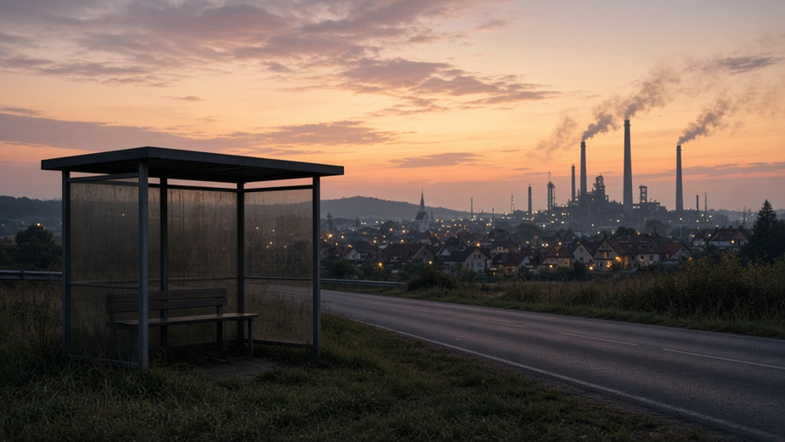
Bus, train or car? The normal madness in the countryside
I live in a village in Staufenberg in Lower Saxony and work in the Waldau industrial area in Kassel. My morning shift starts at 6 a.m. This is a pretty good way to show where the much-cited traffic turnaround in the countryside reaches its limits. Because if the first bus leaves so late that I'm still somewhere between the village and Kassel at the beginning of my shift, the discussion about bus or car is quickly over.
From my home to Waldau it is about 19 to 20 kilometers each way. By car I need roughly 25 to 30 minutes. There and back I get about 40 kilometers and just under an hour of driving time a day.
With public transport, this quickly turns into about an hour or more in each direction. In addition, there are changes, waiting times and the risk that a connection does not fit. In the best case, I spend about two hours a day commuting to work. In the worst case, I simply don't arrive on time in the morning.
In terms of price, it will also be interesting. A single ticket in the KasselPlus area costs 4.40 euros, which would be 8.80 euros per day round trip. With 20 working days, that would be a proud 176 euros if you actually bought single tickets. Of course, that wouldn't make much sense. There are season tickets or the Deutschlandticket for that. But even the cheapest ticket is no help if the timetable doesn't fit the start of work. A ticket can do a lot, but conjuring up a bus is not yet one of its functions.
In addition to the electric car, we also drive a diesel. That's why this comparison is also worthwhile. Assuming seven liters of consumption per 100 kilometers and around 40 kilometers of commuting per day, I need about 2.8 liters of diesel. At a current top price of 2.49 euros per liter, that's just under 7 euros a day. With 20 working days, we end up with around 139 euros for diesel alone.
The electric car, on the other hand, looks much friendlier in terms of direct energy costs. At about 19 kWh per 100 kilometers, it needs around 7.6 kWh of electricity for the same 40 kilometers. Assuming 32 cents per kilowatt hour, this amounts to about 2.43 euros a day or just under 49 euros for 20 working days. If part of the electricity comes from your own solar system, it can be significantly less.
This gives us a very interesting order of magnitude for the same commute: about 49 euros in electricity costs with the e-car, about 139 euros in fuel costs with the diesel and theoretically 176 euros with individual bus tickets per month. For regular bus travel, a monthly ticket or the Deutschlandticket would of course change this calculation. In the case of cars, on the other hand, there are purchases, insurance, maintenance, tires and depreciation. So it would be dubious to claim that a car only costs electricity or diesel.
The real sticking point is another one anyway: e-cars and diesel take me to work in the morning. The bus doesn't do it at this time.
And before the first well-intentioned suggestion comes: "Then why don't you ride an e-bike?"
You can do it.
Almost 20 kilometers in the morning and the same distance after work. In June when the sun is shining, this may be pleasant. In November at five o'clock in the morning, in the dark, four degrees, drizzle and headwind, the enthusiasm is probably a little more restrained. For sporty people, an e-bike can certainly be a real alternative. As a daily mandatory route for a shift worker, however, it is not automatically the miracle solution it is sometimes sold as.
Of course, the cargo bike should not be missing in such discussions. It makes sense for shopping, short distances or transporting children in the city. But for about 40 kilometers of commuting to work a day, I see certain practical limits. Especially since I wouldn't know what to transport in it. In any case, my lunch box doesn't need its own loading area.
The next classic is: "Then move closer to work."
Yes, my God. Theoretically, I could. I could just as well live in the industrial area. Then the commute to work would be perfect and the view would probably be less.
But a place of residence is not just a distance to the workplace. There is my home, there is my family, there is my personal environment and there is the quality of life that I have consciously chosen. A complete move just because public transport does not reflect my working hours is not a serious solution.
In addition, living in cities is often much more expensive. The rent brake may sound reassuring on paper, but in reality it has not exactly turned the search for an apartment into a bargain paradise. If you have a family and need some space, you will quickly realize that "Just move to the city" can be about as helpful financially as "Then just earn more".
In addition, no one knows whether you will stay with the same employer until retirement. Should you keep up with every job change? At some point, private life consists only of moving boxes and forwarding requests.
Then there is the variant: "You complain at a high level, you have a car."
That's right. I have a car and come to work. But that's not the point. The problem affects those who don't have a driver's license, can't afford a car, are still in education or can't drive for other reasons. Those who live in the countryside still have appointments, work, school, shopping and a normal life.
If society wants people to drive less, it must give them a real alternative. Not only theoretically, but at times when people are actually on the road.
Of course, a tram will never pass every five minutes in the countryside. Nobody seriously expects that. A bus with three passengers is economically more difficult than a full line in the city. In addition, there are staffing problems, vehicles, maintenance and the necessary driving licenses and qualifications.
But there is quite a lot of room for manoeuvre between "a bus every five minutes" and "there is no reasonable connection for starting work at six".
After all, it's not just pensioners who go to the doctor in the morning who live in the countryside. Families, employees, trainees, students, nurses, craftsmen and shift workers live here. People with early, late and night shifts. If you want to preserve rural regions, you also have to take their everyday lives seriously.
And the quality of life in the countryside is a real value. More peace, more space, nature on the doorstep, less traffic and for many families simply a more pleasant attitude to life. That's not something you have to justify yourself for.
That's exactly why I'm bothered by the blanket demand that people should simply use buses and trains more often. I have nothing against public transport. On the contrary. If I could come to Waldau in the morning and back after work, that would be quite interesting.
But the offer must fit life and not life the timetable.
With 20 working days, I drive about 17 to 20 hours a month by car. With public transport, this can become 40 hours or more. That's over 20 additional hours just for commuting to work.
Almost three additional working days.
Unpaid, of course.
All of this is my personal view of the matter. I don't claim to know the perfect solution for public transport in the countryside. If someone has a reasonable, affordable and practical idea of how to reliably get from a village in Staufenberg to the Waldau industrial area before 6 a.m. in the morning and back again after work, I'll be happy to listen to it.
I am quite teachable as long as it comes to constructive suggestions. However, "move", "ride a bike" or "look for another job" are not among them for me. These are not traffic concepts, but life advice from the grab box.
Perhaps the future actually lies in smaller on-demand buses, on-demand shuttles, better connections or other flexible models. If something like this works reliably, I'll be on board immediately.
And if a bus leaves at five in the morning to take me to Waldau on time, I'll be happy to get in. He can save himself Wi-Fi, heated seats and breakfast. Arriving on time would be enough for me for the time being.
You may also like

Staff shortage on the menu: When restaurants can no longer open.
Shortage of skilled workers in the gastronomy industry: Why are restaurants closing due to staff shortages? Recently, I wanted to go out for a cozy m…
Read more →
I know I'm not alone in this – about stress, responsibility, and real strain.
Why a full head can make you just as tired as a full day at work Sometimes there are days when I haven't done much physically and still have the feel…
Read more →
Paragraph 40 – Who Pays for the Works Council's Work
A works council works on a voluntary basis, as explicitly stated in Section 37, Paragraph 1, but not on its own account. I consider this distinction …
Read more →Want more between the blog posts? I share photos and short notes on Bluesky.
Comments
Write a comment